What the phrase “so far as is reasonably practicable” really means for electrical safety and the inspection and testing of portable equipment in NSW workplaces.
If you manage electrical safety in a workplace in Sydney metro or in regional NSW, there is an important phrase you will see repeatedly in work health and safety legislation:
‘So far as is reasonably practicable’.
It appears throughout the Work Health and Safety Act and Regulation and helps define what is expected of a person conducting a business or undertaking (PCBU) when managing health and safety risks.
But what does “reasonably practicable” mean in reality? Especially when we are talking about electrical risks and the inspection and testing of electrical equipment?
We need to be very clear here from the outset —
Section 18 of the Work Health and Safety Act 2011 sets out what must be considered when determining what is reasonably practicable.
In simple terms, five matters must be considered and weighed up on balance:
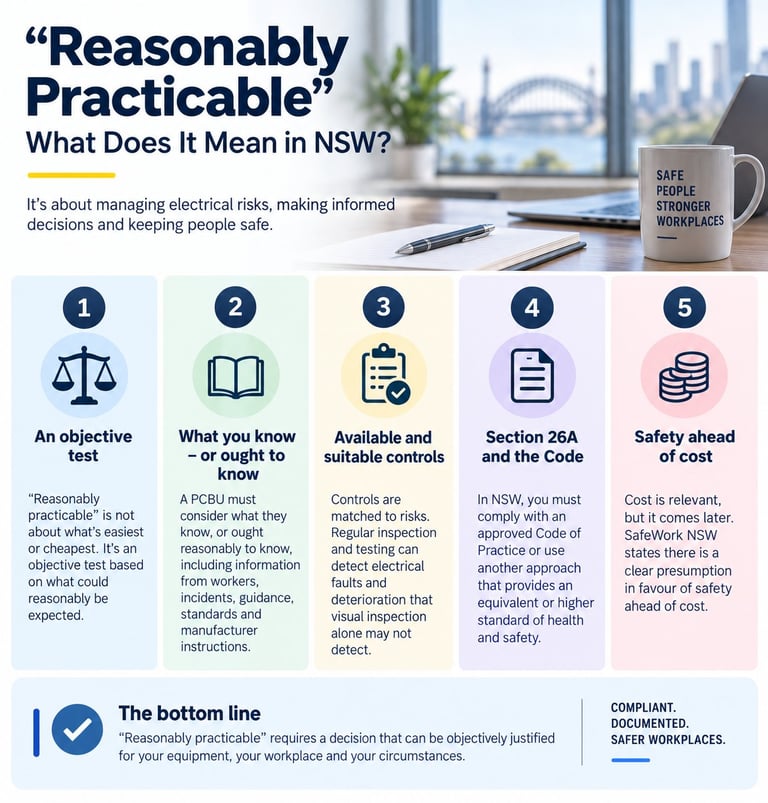
Importantly, SafeWork NSW describes reasonably practicable as an objective test.
The question is not simply what a particular business considers reasonable.
The standard is what could reasonably be expected of a person in that duty-holder’s position who is required to comply with the same health and safety duty.
This is one of the most important parts of the reasonably practicable test.
The law does not consider only what a PCBU actually knows.
It also considers what they ought reasonably to know.
SafeWork NSW refers to this as the state of knowledge.
That knowledge can come from sources including:
This means that managing electrical risk cannot be based solely on what has happened previously at a workplace.
“No one has ever been shocked by it” is not a risk assessment.
A PCBU is expected to proactively identify hazards and consider information that is reasonably available about both the risk and the ways it can be controlled.
SafeWork NSW distinguishes between a control being available and being suitable.
Controls are matched to risks.
Electrical risks identified are matched to controls selected to manage those risks. For example, electrical risks linked to fixed wiring (as per AS/NZS 3000:2018 — Electrical installations — the Australian/New Zealand Wiring Rules) in workplaces may best be handled by a licensed electrician.
Once the risk is understood, the next question is what can be done about it?
Especially when we consider what is the best way to identify, and then manage, hidden electrical risks in portable electrical equipment?
From the Code of Practice
Managing Electrical Risks in the Workplace — section 3.2, page 21
“Regular testing can detect electrical faults and deterioration that cannot be detected by visual inspection”.
This makes regular inspection and testing an important control for a PCBU to consider when determining how electrical risks will be identified and managed.
Consider regular test and tag as a means to identify hidden electrical risks, and consider using it to apply a range of controls to manage other electrical risks identified as a function of what is required for each individual piece of failed electrical equipment.
Note: regular test and tag is not the whole solution.
It is one part of an electrical risk-management system, not the entire system itself. It is an administrative control in the hierarchy of controls.
This has become particularly important in NSW.
Section 26A of the Work Health and Safety Act now requires a duty-holder to comply with an approved Code of Practice or manage hazards and risks in another way that provides a standard of health and safety that is equivalent to or higher than the standard required by the Code.
For electrical risk, the NSW Managing Electrical Risks in the Workplace Code of Practice provides detailed information about identifying electrical hazards and selecting appropriate controls.
It clearly states the value of regular test and tag in relation to the management of electrical risks and perhaps more importantly, what a PCBU should reasonably know and do in relation to their statutory obligations in managing this risk.
SafeWork NSW also states that a court may have regard to an approved Code of Practice when determining what was reasonably practicable in the circumstances.
The Code therefore cannot simply be ignored because a business has historically managed electrical equipment another way.
If a different approach is used, the question becomes whether it achieves an equivalent or higher standard of health and safety and whether that can be supported by evidence, rather than documentation alone.
Nope. Not even close.
Cost is relevant for all businesses, regardless of their size, but it comes later in the process.
SafeWork NSW states that there is a clear presumption in favour of safety ahead of cost.
Safety ahead of cost.
Direct from the regulator. Let that sink in.
The extent of the risk and the available ways of eliminating or minimising it must be considered before cost is weighed. Where several controls provide the same level of protection, choosing the less expensive option may be entirely reasonable. This is common sense.
What is unlikely to satisfy the ‘reasonably practicable’ test is choosing a cheaper option simply because it costs less when it provides a lower level of protection.
Such as never testing anything ever for hidden electrical faults.
“Reasonably practicable” does not require businesses to eliminate every conceivable risk regardless of circumstance or cost either.
But neither does it allow a business to choose the easiest approach, or no approach, without properly considering the risk. It requires a decision that can be objectively justified.
For electrical safety, that means being able to explain:
What was the risk?
What did we know — or what should we reasonably have known?
What controls were available and suitable?
What did we do?
And why was that approach appropriate for this equipment, this workplace and these circumstances?
Furthermore, a competent technician will have a range of tests and methods available at their disposal to assess whether or not a piece of portable electrical equipment is safe or unsafe.
Their service is not a ‘one-test-fits-all’ equipment type of service.
That is a much stronger basis for electrical safety than simply asking:
“What is the longest period of time we can wait before we do testing again?”
Or worse.
“Test and tag is a luxury tax on my business”
Not sure whether your current inspection and testing approach “stands up” to the reasonably practicable test? Talk to Liberty Test & Tag about a risk-based testing schedule designed around your equipment, your workplace and your circumstances.
This article provides general information about electrical safety and work health and safety requirements in NSW. It is not legal advice. PCBUs should consider their particular workplace circumstances and refer to current NSW legislation, applicable Codes of Practice and relevant Australian Standards.