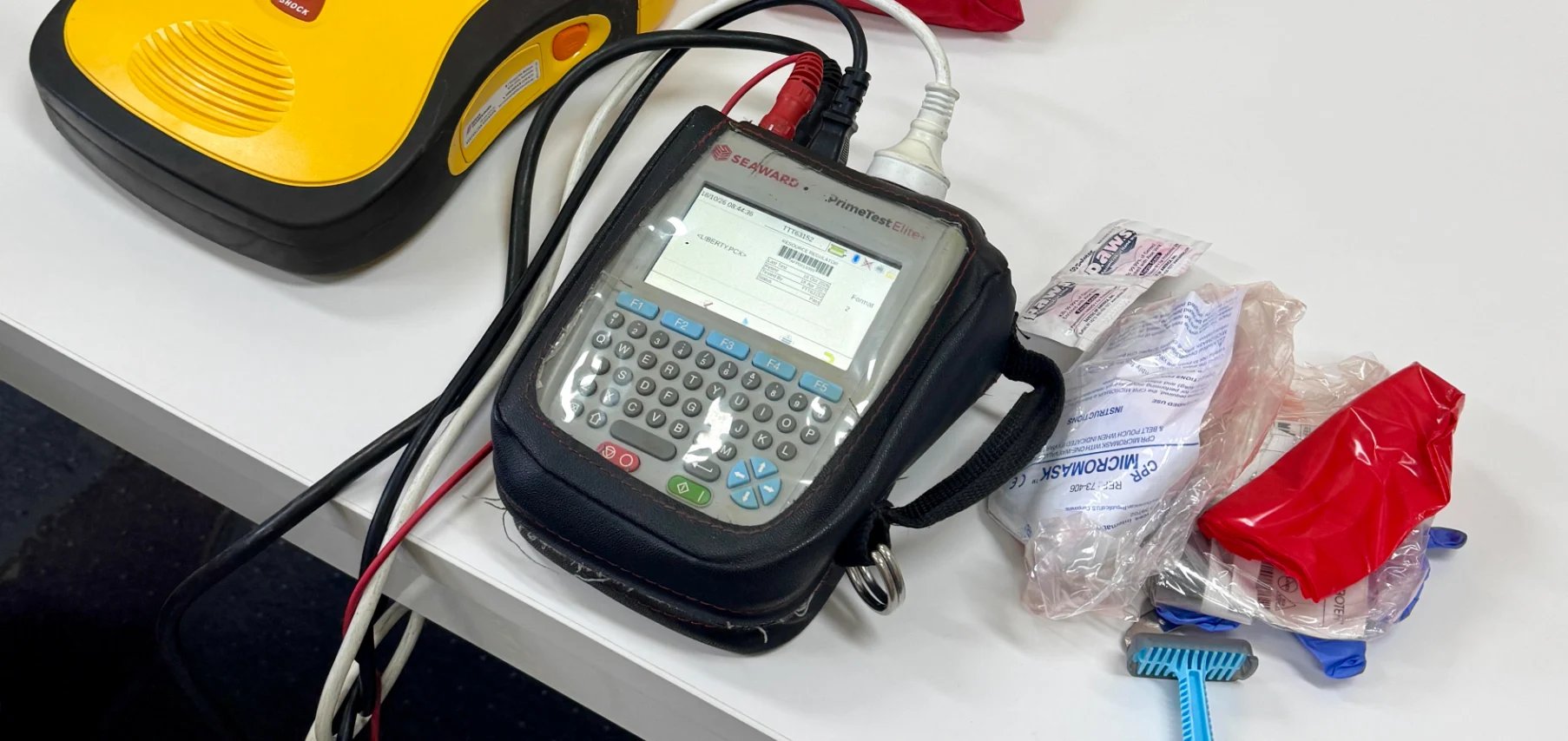
We ensure your Automated External Defibrillators are ready for use and compliant with manufacturer service requirements. Serving schools, offices, warehouses, and worksites across Sydney, Canberra, and Lithgow.
Routine inspection of workplace AED units to confirm they are accessible, ready for use and maintained in accordance with manufacturer requirements.
Safe Work Australia First Aid in the Workplace Code of Practice and the AED manufacturer's maintenance instructions.
We provide workplace AED readiness inspections designed to identify issues that could affect whether your AED is ready for use in an emergency.
Our inspection includes:
Expired pads, battery warnings, damaged components or other readiness issues are identified so corrective action can be arranged.
Important: Liberty Test & Tag provides workplace AED readiness inspections. We do not perform biomedical performance testing or AS/NZS 3551 certification.
Inspection frequency depends on the AED manufacturer, workplace conditions and risk assessment.
As a practical approach:
AED manufacturers provide specific instructions for checking, maintaining and replacing consumable components such as electrode pads and batteries.
Liberty Test & Tag uses available manufacturer information as part of the workplace AED readiness inspection.
Our inspection focuses on:
Important: Liberty Test & Tag does not perform biomedical performance testing or AS/NZS 3551 certification.
AED readiness inspections can be completed alongside Test & Tag, RCD testing, fire equipment servicing, emergency and exit light testing and ladder inspections, helping reduce repeat site visits and simplify workplace safety records.
AED readiness inspections start from $25 per AED when bundled with other scheduled workplace safety services, such as Test & Tag or fire equipment servicing.
Bundling AED inspections with other on-site compliance work helps reduce additional site attendance costs and makes it practical to check multiple workplace safety items during the same visit.
For standalone AED inspections or sites with multiple AEDs, contact Liberty Test & Tag for a quote.
Get an AED Inspection QuoteExpired electrode pads, battery warnings or a failed readiness indicator may not be noticed until the AED is needed.
Book an AED InspectionNSW uses its own approved Code of Practice, while the ACT applies the Model Code of Practice issued by Safe Work Australia.
In NSW and the ACT, AEDs fall under your general duties in the Work Health and Safety Act 2011 and the First aid in the workplace Code of Practice. There is no separate law mandating that every workplace must have an AED, but the Code outlines when providing one should be considered.
According to the Code of Practice (Section 3.3 Other First Aid Equipment), workplaces should consider providing an AED if:
AEDs are designed to be used by trained or untrained people. They give step-by-step instructions, detect whether defibrillation is appropriate, and will not shock a person unless required. AEDs should be clearly visible, accessible, away from extreme temperatures, and maintained according to manufacturer specifications.
Regular AED readiness inspections help identify expired consumables, warning indicators, physical damage and accessibility issues before an emergency occurs.
AED pads expire, batteries require replacement and devices may display warning indicators or failed self-tests.
Routine inspections help identify these issues before the AED is needed.
Maintaining accessible and ready-to-use first-aid equipment forms part of effective workplace risk management.
AED inspection records can help demonstrate that workplace equipment is being monitored and maintained.
Liberty provides clear records of the AEDs inspected, their observed condition and any actions identified during the inspection.
Beyond the inspection itself, Liberty can help identify replacement consumables, record AED details and provide practical recommendations where readiness issues are found.
Check accessibility, visibility and storage location.
Assist with identifying and sourcing compatible replacement pads, batteries and accessories.
Provide clear records of the AED inspection and identified actions.
Where appropriate, recommend that workplaces consider suitable CPR and AED training for staff.
Ensure your life-saving equipment is ready when it matters most. Professional AED inspections across Sydney, Canberra, and Lithgow.
Guidelines Followed
Inspection Reports
Servicing schools, offices, warehouses, and worksites across Greater Sydney, Canberra, Lithgow & Regional NSW
Use our Test & Tag Pricing & Cost Calculator to estimate the cost of portable electrical equipment testing for your workplace.
View Test & Tag Pricing & CalculatorLooking to simplify your compliance? Explore our other workplace safety services:
Ensure all portable electrical equipment is safe and compliant.
Verify your RCDs trip within the required safety thresholds.
Maintain critical fire protection equipment.
Keep evacuation lighting functional and audit-ready.
Confirm ladders are safe, stable, and compliant.
All services can be bundled with your AED visual inspection in a single visit.