Serving Sydney, Canberra and regional NSW.
Verify RCD trip performance and maintain clear compliance records for your workplace.
We help businesses manage electrical risk by verifying RCD performance.
Mandatory verification that Residual Current Devices (safety switches) disconnect power fast enough to prevent lethal electric shock during an earth leakage fault.
AS/NZS 3760:2022 (In-service safety inspection and testing)
Covers both portable RCD units and switchboard-mounted (fixed) safety switches.
Residual Current Devices (RCDs)—also known as safety switches—are one of the most important electrical protection devices in your workplace. Their role is simple: if electricity starts flowing somewhere it should not—such as through a damaged appliance, exposed cable or a person—they disconnect the power in milliseconds, significantly reducing the risk of electric shock.
However, an RCD is not a "fit and forget" device. Internal components can deteriorate over time, and a safety switch can appear normal while failing to operate correctly under a genuine fault condition. That means the first time you discover a failed RCD could be during an electrical incident.
SafeWork NSW recommends regular testing to confirm that RCDs operate as intended. Professional testing uses calibrated equipment to measure actual trip times and, where required, trip current performance—providing objective evidence that your safety device is functioning correctly.
For businesses, schools and organisations, documented RCD testing supports a proactive approach to electrical safety, helps maintain compliance records and provides confidence that the devices designed to protect people will work when they are needed most.
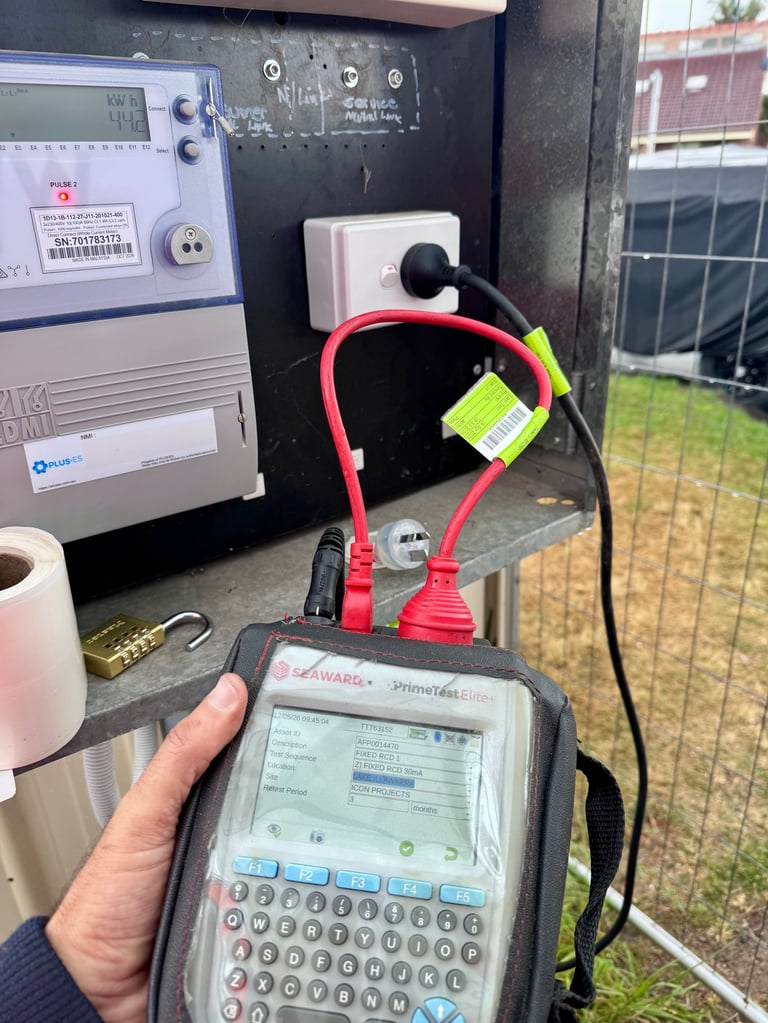
Pressing the test button confirms the mechanical operation of the RCD but does not measure trip time or verify operating performance under calibrated test conditions. Professional testing provides measurable results and recorded trip times. If you're unsure whether your workplace still requires testing, read our guide on current NSW requirements.
Book your RCD test nowWe test fixed RCDs through accessible socket outlets, as well as portable RCDs used with workplace equipment. Testing measures operating performance, with trip times recorded on tags and digital compliance reports.
Examine switchboard and RCD condition, checking for damage, corrosion, or signs of overheating
Measure RCD trip performance using calibrated testing equipment in accordance with AS/NZS 3760 requirements.
Trip time is recorded on the RCD tag (e.g., 18ms) for traceable, audit-ready results
Verify the RCD trips at the correct residual current threshold (30mA for personnel protection). A ramp test gradually increases current until the device trips, confirming it operates within the rated sensitivity rather than too early (nuisance tripping) or too late (safety risk).
Every RCD tested receives a durable tag showing trip time, test date and next due date. A full compliance report is issued for your records — clear documentation of test results to support your workplace electrical safety records.
A push-button test confirms that the RCD operates — it trips the device and shows the mechanism works. It does not measure how long the device takes to trip, so it does not validate actual trip time.
Instrument testing measures the trip time using calibrated equipment, so the result can be assessed against the applicable limit for that RCD. A push-button check is not equivalent to measured trip-time testing.
| RCD type | Test current (AC) | Maximum trip time |
|---|---|---|
| Type I RCD | 10 mA | 40 ms |
| Type II RCD | 30 mA | 300 ms |
Each limit applies to the stated RCD type at the stated test current. Type I and Type II in this table are distinct from Type A and Type AC RCD classifications.
Workplace RCDs require regular testing by a competent person. The testing schedule depends on the RCD type, workplace environment and applicable requirements.
See the indicative testing intervals below for fixed and portable RCDs. Read these intervals alongside clause 2.2 of AS/NZS 3760:2022.
If an RCD does not operate correctly or trips repeatedly, arrange assessment to identify the cause.
Keep instrument test results available for workplace safety reviews and audits.
Table 2.4 of AS/NZS 3760:2022 provides indicative intervals. These intervals must be read with the standard as a whole — particularly clause 2.2 — and are not a single schedule that applies to every workplace. A dash means the table shows no applicable value for that row; it does not mean testing is never required.
| Workplace environment | Portable RCD — push-button check | Fixed RCD — push-button check | Portable RCD — measured operating-time test | Fixed RCD — measured operating-time test |
|---|---|---|---|---|
| Factories, workshops, manufacturing, assembly, maintenance or fabrication | Daily or before every use, whichever is longer | 6 months | 12 months | 12 months |
| Equipment or supply cords subject to flexing in normal use, abuse, or a hostile environment | 3 months | 6 months | 12 months | 12 months |
| Equipment or supply cords not subject to flexing in normal use, not open to abuse, and not in a hostile environment | 3 months | 6 months | 2 years | 2 years |
| Residential-type areas of hotels, residential institutions, motels, boarding houses, halls, hostels, accommodation houses and similar premises | 6 months | 6 months | 2 years | 2 years |
| Equipment used for commercial cleaning | Daily or before every use, whichever is longer | — | 6 months | — |
| Hire equipment | Push-button testing by the hirer before hire | — | 3 months | 12 months |
Source: AS/NZS 3760:2022, Table 2.4. Intervals are indicative and must be read with the standard as a whole, particularly clause 2.2. Specialist environments (including construction and medical settings) are not reproduced here.
Certified RCD testing across Sydney, Canberra, Lithgow and regional NSW — compliant with AS/NZS 3760 and SafeWork NSW standards.
Our technicians are trained in AS/NZS 3760 procedures and use calibrated equipment to perform accurate RCD testing.
Clear upfront quotes with no hidden fees. Volume discounts available
Same-day service available across Greater Sydney metro areas
Schools, offices, warehouses, hospitality venues and industrial facilities — we tailor RCD testing to suit your workplace environment and compliance requirements, including three-phase equipment testing where required. RCD testing can be booked alongside portable appliance Test & Tag, helping you coordinate electrical safety checks in one visit.
Comprehensive documentation for insurance, audits, and compliance
We remind you when your next inspection is due
Common questions about residual current device testing
Understanding your workplace electrical safety responsibilities is important. SafeWork NSW provides practical guidance on managing electrical risks, including the use of residual current devices (RCDs), inspection and testing of electrical equipment, and maintaining safe workplaces.
Useful resources include:
These resources provide independent guidance to help businesses understand their electrical safety responsibilities and implement effective risk controls.
Comprehensive electrical safety and compliance solutions for your workplace
AS 1851 compliant testing and maintenance for fire extinguishers, fire blankets, fire hose reels, and emergency lighting to keep your workplace fire-safe.
Learn moreComprehensive electrical test and tag services for all portable appliances under AS/NZS 3760 to protect your staff and meet WHS requirements.
Learn moreSee Test & Tag pricing, calculate an estimate or request a fixed quote for your workplace.
View Pricing & CalculatorDon't wait for an electrical incident. Ensure your RCDs are protecting your workplace with certified testing from Liberty Test & Tag.