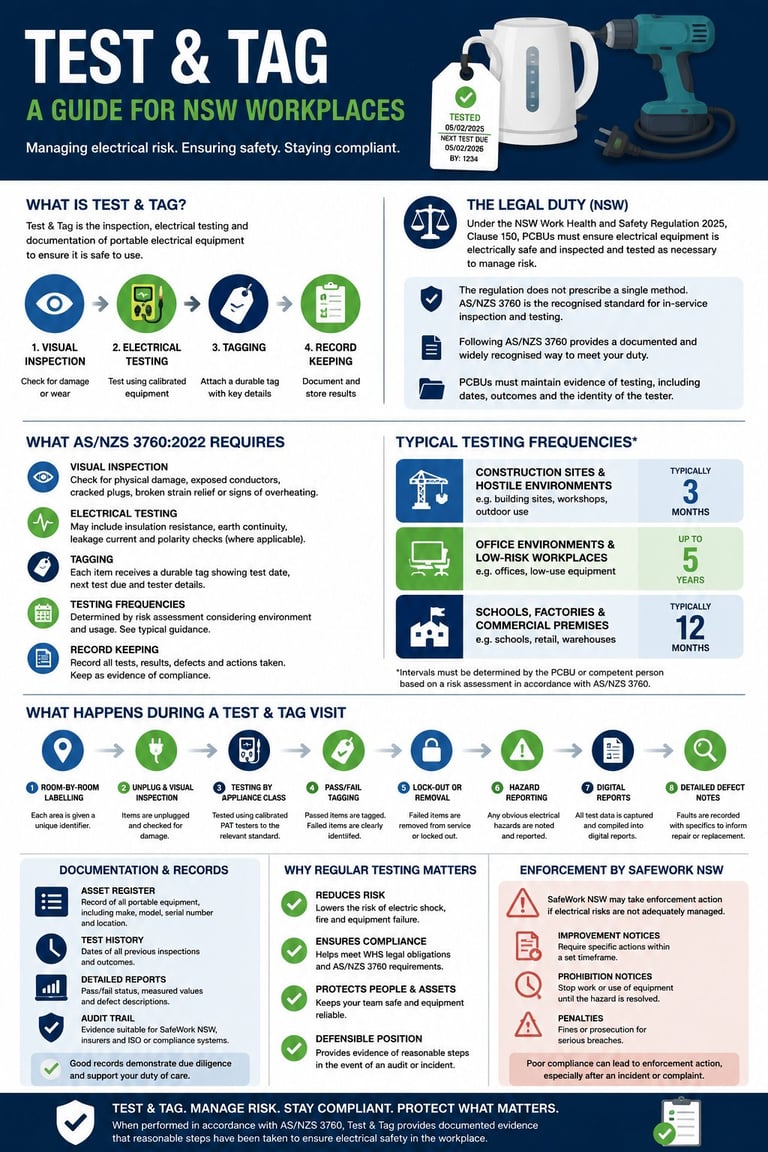
Test & Tag is the common name for the inspection, testing, and documentation of portable electrical equipment. For NSW workplaces, Test & Tag is a widely recognised method of managing electrical risks, providing documented evidence that portable equipment has been inspected and tested as part of a workplace safety program.
This guide explains what Test & Tag is, the legal duties it helps meet, what AS/NZS 3760 requires, and how the process works in real workplaces.
Need compliant Test & Tag for your workplace? Liberty provides AS/NZS 3760 testing, clear digital reports and minimal disruption across NSW and ACT.
What Is Test & Tag?
Test & Tag is a process used to check whether portable electrical equipment is safe to use. It involves four steps:
- Visual inspection – checking for damage to plugs, cords, and the appliance itself
- Electrical testing – using calibrated equipment to measure insulation resistance, earth continuity, and leakage current
- Tagging – attaching a durable label showing test date, next test due, and tester details
- Record keeping – documenting results in an asset register or compliance report
The process applies to portable items like computers, kettles, power tools, printers, and extension leads—not fixed wiring or switchboards.
Test and Tag Requirements in NSW
In NSW, Test and Tag requirements sit within a hierarchy of laws, codes and standards rather than a single standalone rule. The chain runs as follows:
- WHS Act section 26A – requires a PCBU to comply with an approved Code of Practice relevant to the hazards and risks associated with the work, or use another method that provides an equivalent or higher standard of work health and safety.
- Approved Code of Practice – practical guidance on how the duty applies to managing electrical risks in the workplace
- WHS Regulation – the specific legal obligations, including Clause 150, which requires electrical equipment to be electrically safe and inspected and tested as necessary to manage risk
- AS/NZS 3760 – the recognised testing methodology and in-service inspection and testing framework used to meet those obligations
Under the NSW Work Health and Safety Regulation 2025, Clause 150 requires a PCBU to ensure electrical equipment is electrically safe and inspected and tested as necessary to manage risk.
The regulation does not prescribe a single method. However, AS/NZS 3760 is the recognised Australian/New Zealand Standard for in-service safety inspection and testing of electrical equipment. Following this standard provides a documented and widely recognised method of demonstrating that the legal duty has been met.
For a complete breakdown of what NSW law requires — including penalties, enforcement, and practical compliance steps — read our detailed guide: Is test and tag a legal requirement in NSW?
PCBUs must also maintain evidence that inspection and testing has been carried out. This includes dates, outcomes, and the identity of the person who performed the work.
What AS/NZS 3760 Requires
AS/NZS 3760:2022 sets out the technical requirements for inspecting and testing portable electrical equipment. The standard specifies the methods, test limits, and documentation expected for in-service electrical equipment across a range of workplace environments.
Visual Inspection
Every item must be checked for physical damage, exposed conductors, broken strain relief, cracked plugs, or signs of overheating before any testing is done.
Electrical Testing
Depending on the equipment design and testing method, electrical testing may include insulation resistance, earth continuity, leakage current, and polarity checks where applicable.
Tagging
Each tested item receives a durable tag showing the test date, next test due date, and the tester's details. Tags must remain legible and attached throughout the test period.
How Often Does Electrical Equipment Need to Be Tested and Tagged in NSW?
There is no single NSW interval for every workplace. The appropriate interval depends on the environment, the equipment and the level of risk associated with its use. Intervals set out in AS/NZS 3760 are maximum indicative intervals rather than fixed rules, AS/NZS 3012 applies specific requirements on construction sites, and the final decision must be supported by a risk assessment. In practice, this means hostile or construction environments are tested far more frequently than low-risk office equipment.
For the full breakdown of indicative intervals by environment and how risk assessment shapes them, see our complete guide to Test & Tag intervals in NSW.
Record Keeping
Every test must be recorded. Records should include appliance details, test results, pass or fail status, and any defects identified.