Fire safety maintenance requirements changed in NSW on 13 February 2026.
From that date, owners of new and existing Class 1b and Class 2–9 buildings must ensure applicable essential fire safety measures are inspected, tested and serviced in accordance with AS 1851-2012 – Routine service of fire protection systems and equipment, unless the relevant maintenance activity is addressed by an approved performance solution.
On paper, the requirement is reasonably straightforward.
In practice, there is considerable confusion about what a fire equipment inspection actually involves, how often equipment needs to be serviced, what records need to be kept and even what equipment a workplace should have.
One of the biggest misunderstandings I encounter is particularly simple:
Inspecting fire equipment means actually inspecting it. Punching a service tag is not the inspection.
Section 81A of the Environmental Planning and Assessment (Development Certification and Fire Safety) Regulation 2021 applies from 13 February 2026.
It requires building owners to ensure maintenance activities for applicable essential fire safety measures are undertaken in accordance with an approved performance solution where one addresses that maintenance activity, or otherwise in accordance with AS 1851-2012 where the activity is covered by the Standard.
The Regulation defines maintenance activities as inspection, testing and servicing. AS 1851 describes the broader process as routine servicing, which includes inspection, testing, preventive maintenance and survey.
Section 81A also requires applicable records to be kept on site for at least 7 years and made available for inspection by the Fire Commissioner or relevant council.
So when people talk about a “fire inspection”, “fire testing” or “fire servicing”, they may be describing different parts of the broader routine servicing process.
The requirements apply to new and existing Class 1b and Class 2–9 buildings in NSW. This includes many offices, shops, warehouses, industrial sites, medical facilities, childcare centres, accommodation buildings and other commercial premises.
Typical Class 1a detached homes are not covered by this particular AS 1851 requirement.
For building owners and managers, the Fire Safety Schedule (FSS) or Annual Fire Safety Statement is an important starting point for establishing which essential fire safety measures apply to the building.
There is an important qualification for older buildings. Some pre-1997 buildings may not have a Fire Safety Schedule even though essential fire safety measures still apply. The NSW Regulation refers to these as original measures, which must continue to be maintained to a standard no less than that to which they were originally designed and implemented.
AS 1851-2012 covers a broad range of fire protection systems and equipment.
For the portable fire equipment we commonly encounter, this includes:
AS 1851 also covers other fire protection systems and equipment. Some require different competencies, specialist contractors or licensed trades.
This distinction matters.
A technician qualified to inspect and service portable fire equipment is not automatically qualified to work on every fire safety system in a building.
Fire detection and alarm panels, for example, are outside our current scope. We also don't perform hydrant flow testing.
NSW Government guidance makes the same broader point: AS 1851 work can involve both specialist and non-specialist work, and specialist work may require the appropriate trade licence depending on what is being done.
This is where there can be a substantial difference between seeing a punched service tag and understanding what was actually done.
When I inspect a portable fire extinguisher, it comes off the bracket.
That allows me to perform a 360-degree inspection of the extinguisher from the assembly at the top down to the base rather than simply looking at the front of a cylinder hanging on a wall.
The exact inspection and testing performed depends on the extinguisher type and applicable service requirements.
An ABE dry chemical powder extinguisher provides a good example of what this can look like in practice.
As part of my inspection process, I invert the extinguisher and listen for the powder moving down the inside of the cylinder. If the powder isn't moving freely, the base can be tapped to help shift compacted powder.
That isn't something I do with every extinguisher type. CO₂, wet chemical and other extinguishers are different equipment and are inspected accordingly.
There are also very ordinary things that only become apparent when someone actually examines the equipment.
We find dirt and debris. Insects and spiders can get into components. Operating instructions become badly faded. Cylinders can develop corrosion or physical damage. Hoses, nozzles and other components need to be examined.
The service tag is part of the servicing process.
The tag is not the service.
An extinguisher can be present and serviceable but still be inappropriate for the risk it is expected to address.
I encountered a striking example of this in an open-plan office filled with computers and other electrical equipment.
Less than 3 metres from an employee's desk was a 9 L water fire extinguisher.
The employee believed it was an ABE dry chemical extinguisher. She told me that if there was a fire involving her computer, she would have picked it up and used it.
That conversation demonstrated why simply asking “Do we have a fire extinguisher?” isn't enough.
The type, size and fire rating matter because different extinguishers are intended for different classes and sizes of fire.
It is also why our asset records identify the extinguisher itself — including its type, size, make and rating — rather than simply recording that an “extinguisher” exists at that location.
The letters and numbers printed on an extinguisher aren't simply product codes.
They provide information about the classes of fire for which the extinguisher is rated and its performance against the applicable test fires.
An ABE dry chemical extinguisher therefore isn't interchangeable with a water, CO₂ or wet chemical extinguisher simply because all of them happen to be red cylinders.
Size matters as well.
For example, a 4.5 kg ABE extinguisher may be more practical for many people in an office environment to handle than a 9 kg unit. Equipment selection therefore involves more than simply installing the largest extinguisher available.
The equipment needs to suit the risk, required coverage and workplace in which it is expected to be used.
Fire blankets are another good example of why the equipment itself needs to be examined.
I've inspected fire blankets that appear to have been used and then put back into their containers.
This is particularly relevant in commercial kitchens and mobile food businesses.
In my own inspections, I remove enough of the blanket to examine its condition. Evidence of previous use can become quite obvious: staining, brown areas, heat damage, contamination and fraying can be visible once the blanket is taken out and examined.
I've also encountered blankets poorly located around cooking areas or without appropriate signage.
If a blanket has been used or is no longer suitable for service, we recommend replacement. We carry replacement fire blankets, so where authorised by the client, the defective blanket can usually be replaced during the same visit.
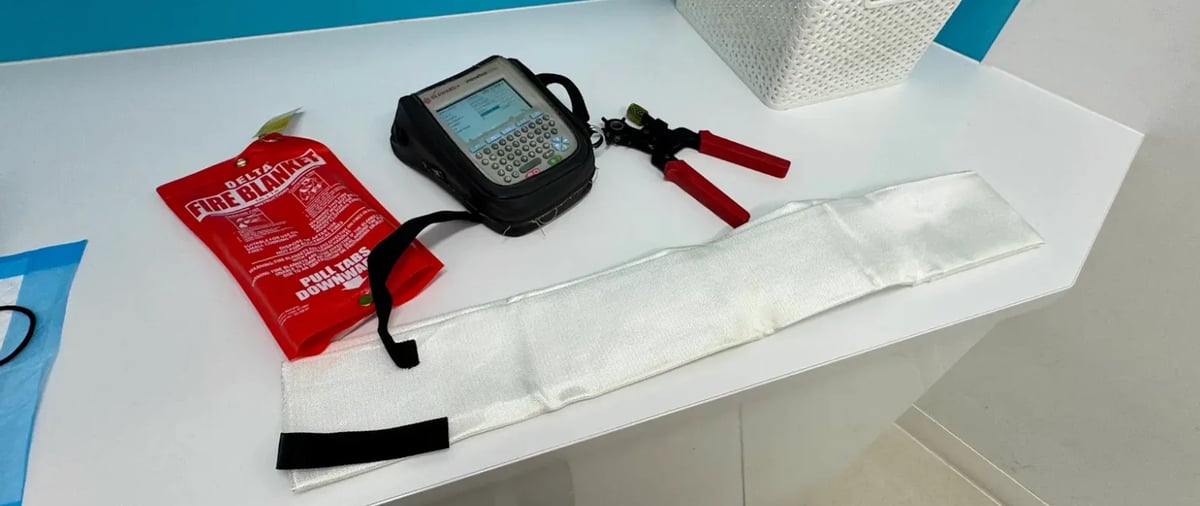
A container hanging on the wall doesn't tell you what condition the blanket inside it is in.
Fire hose reels also require actual inspection and testing.
This sometimes surprises clients.
I've had clients watch me unwinding a hose reel during servicing and ask what I'm doing because:
“The previous guy didn't do that.”
That comment tells you something important.
A service tag attached to a hose reel tells you very little about what was physically inspected or tested.
The applicable AS 1851 service requirements determine what needs to be done at the relevant service interval.
AS 1851 doesn't prescribe one identical inspection that is simply repeated indefinitely.
Different routine service schedules apply depending on the equipment and service interval.
For portable fire extinguishers, for example, there are 6-monthly, yearly and 5-yearly service schedules, with different activities applying at different intervals.
Fire blankets and fire hose reels also have routine service requirements.
The environment in which equipment is installed can also matter. AS 1851 contains additional provisions for equipment exposed to adverse environments.
The important point for a building owner or manager is that the date punched into a service tag doesn't, by itself, tell you what servicing was actually required or performed.
Not necessarily.
I've taken over sites where equipment carried current or previous service tags but other problems were still apparent.
I've encountered inappropriate or poorly installed signage, extinguishers in questionable locations, badly faded operating instructions, corrosion and equipment whose physical condition required further attention.
I've seen fire signs poorly attached — including signs fixed with temporary adhesive products — and signage bought or printed without adequate consideration of whether it was appropriate for the installation.
That doesn't mean a customer should automatically assume the previous contractor did something wrong.
It means customers should understand what they are actually paying to have done.
Building Commission NSW recommends that owners check whether a contractor is appropriately licensed where required, ensure they are competent where a licence isn't required, request recommendations in writing and compare scopes of work when considering competing quotes.
A cheap price and a newly punched service tag don't tell you what happened between the technician arriving and leaving.
This is another problem we encounter.
A manager once estimated that a site had around 8–11 fire extinguishers requiring attention.
Once the actual requirements were established, there was a gap of more than 30 additional extinguishers, together with the associated signage.
That's a substantial difference.
It demonstrates why knowing the scope involves more than asking somebody how many extinguishers they remember seeing.
A building owner or manager needs to understand:
What equipment is currently in service? Where is it? What type and rating is it? What condition is it in? And are there gaps?
That is where a proper asset register becomes particularly valuable.
When we identify defective equipment, we don't simply leave the client with an unexplained “fail”.
The asset is recorded as defective and the reason for the failure is documented against it.
Where appropriate, we photograph the defect as well. This is particularly useful where the person responsible for the site isn't present during the inspection and wants to see exactly what was found.
That might be corrosion, rust, a damaged pressure gauge, deteriorated equipment, a signage issue or another identifiable defect.
The defective equipment is also physically marked accordingly.
Where an extinguisher requires replacement, we can quote the replacement, source it, inspect and tag the new extinguisher, add it to the fire asset register, deliver it and install it.
Where possible, extinguishers removed from service are returned through our supplier so they can be appropriately recycled, broken down into components or reconditioned and returned to service where suitable. This is particularly relevant to equipment such as CO₂ extinguishers.
Fire blankets can generally be replaced directly.
If a hose reel requires plumbing or repair work outside our scope, we refer that work to the appropriate trade.
This is one of the important changes building owners need to understand.
Section 81A requires applicable records required by AS 1851-2012 or an approved performance solution to be kept on site for at least 7 years and made available for inspection by the Fire Commissioner or relevant council.
Building Commission NSW currently states that AS 1851-2012 requires a hard-copy logbook to be left on site at the completion of testing. Electronic reporting can supplement those records, but current NSW guidance says an electronic register cannot yet replace the required physical logbook.
For building owners using digital compliance systems, that distinction is important.
Detailed digital reporting is extremely useful, but it should not be assumed to remove the separate AS 1851 on-site record-keeping requirement.
Our own fire reporting records individual assets rather than simply providing a total number of extinguishers serviced.
Depending on the asset, our reports record information including:
The detailed fire test results then record the individual servicing activities and results associated with that asset.
No.
This is another area where there is considerable confusion.
Routine inspection, testing and servicing under AS 1851 is not the same process as an Annual Fire Safety Statement (AFSS).
NSW Government guidance states that a person does not need to be an Accredited Practitioner (Fire Safety) simply to undertake AS 1851-2012 work. The person must nevertheless be competent, and some specialist work requires the appropriate trade licence or qualification.
The AFSS is a separate process involving assessment of the essential fire safety measures applicable to the building by appropriately accredited practitioners.
AS 1851 servicing and the AFSS therefore interact, but they aren't interchangeable.
Building Commission NSW specifically states that there is no strict requirement for every AS 1851 inspection and test item to be completed before an AFSS is lodged. However, an AFSS assessor may consider the outcomes of AS 1851 inspections when carrying out their assessment.
Emergency and exit lighting needs to be treated separately.
Building Commission NSW specifically identifies emergency exit lighting as an example of an essential fire safety measure not covered by AS 1851-2012.
Where an essential fire safety measure isn't covered by AS 1851, section 81 still requires it to be maintained to the standard specified in the Fire Safety Schedule or, for an original measure, to the standard to which it was originally designed and implemented.
Emergency and exit lighting is commonly inspected and maintained under AS/NZS 2293.2.
Liberty provides emergency and exit light testing as a separate service with its own documentation.
Start by establishing the actual scope.
Check the building's Fire Safety Schedule and Annual Fire Safety Statement, where applicable. Establish which essential fire safety measures are installed and what existing servicing records are available.
Then establish what is actually present on site rather than relying on an estimated number of extinguishers, blankets or hose reels.
When engaging somebody to undertake the work, ask a very simple question:
What exactly are you going to inspect and test?
If the answer amounts to little more than punching the service tags, you haven't learned very much about the condition of your fire equipment.
Liberty Test & Tag provides routine inspection and servicing of portable fire extinguishers, fire blankets and fire hose reels within our scope and competency.
We don't service fire detection or alarm panels and we don't perform hydrant flow testing.
Fire equipment servicing can also be completed during the same site visit as electrical test and tag, RCD testing, ladder inspections, AED inspections and emergency and exit light testing where required.
Each fire asset we service is individually recorded so the client has documentation showing what was inspected, where it was located and the result.
If you're unsure when your fire equipment was last properly inspected, what equipment is actually on site, or what the NSW changes that commenced on 13 February 2026 mean for your building, we can help establish the scope.
For the NSW Government's current guidance on these requirements, see Building Commission NSW — Responsibilities of building owners under AS 1851-2012.