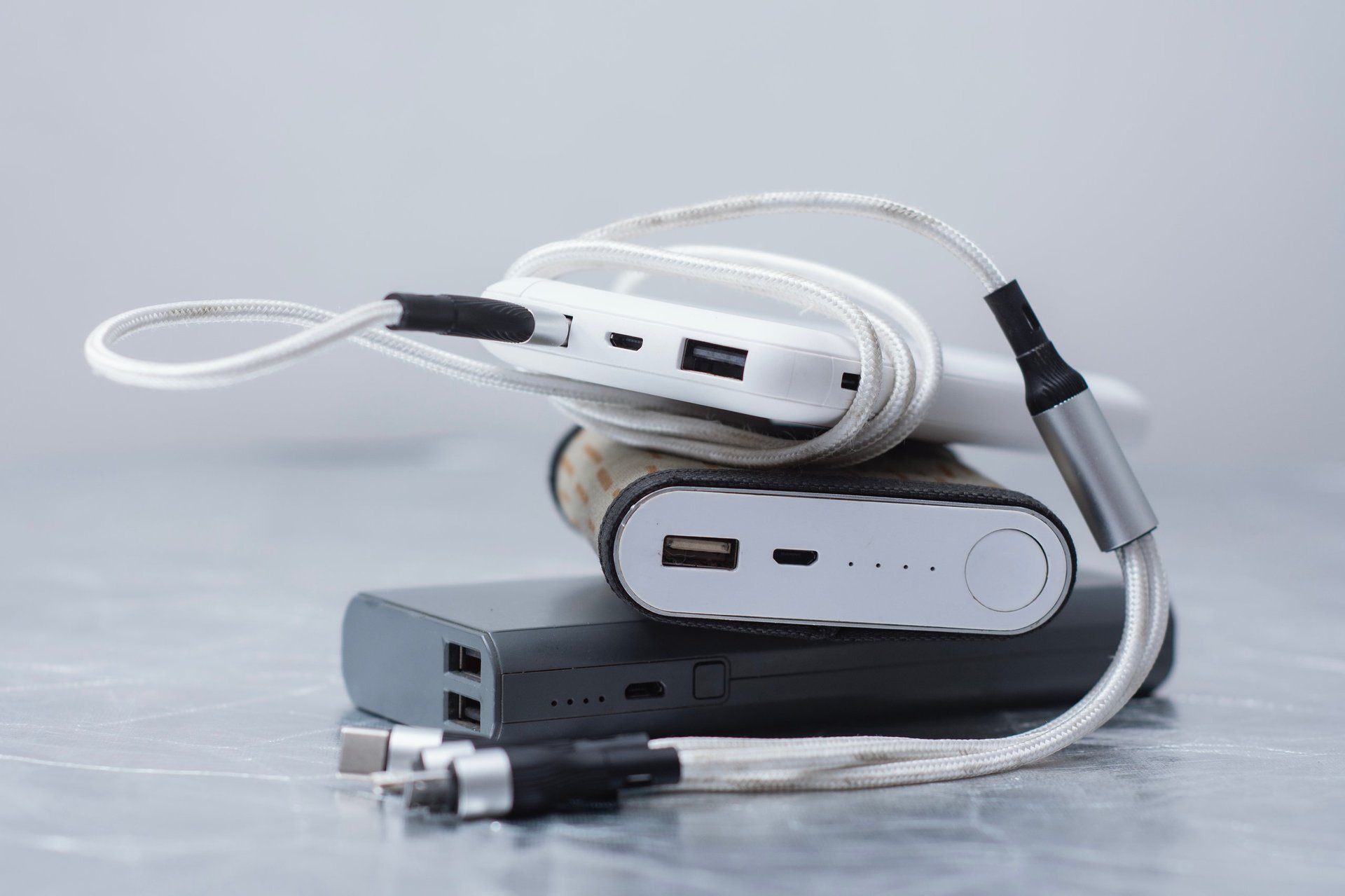
Would you know if a recalled power bank was on your site right now?
ACCC recalls, thermal runaway warning signs, safe charging, workplace duties and what test and tag can — and cannot — tell you about a lithium-ion battery.
Yes. Power banks can overheat, catch fire or release toxic gases if their internal lithium-ion batteries fail. The Australian Competition and Consumer Commission (ACCC) has issued multiple product recalls, while Fire and Rescue NSW warns that lithium-ion battery fires can develop rapidly and may reignite after appearing to be extinguished.
Electrical testing does not certify the internal safety of lithium-ion batteries. A visual inspection can find external defects — it cannot see inside a battery cell.
A power bank is a portable rechargeable battery used to charge mobile phones, tablets, laptops and other electronic devices without needing a mains power outlet.
Most contain lithium-ion or lithium-polymer batteries and use USB-A or USB-C connections. The power bank itself is recharged using a suitable mains-powered adaptor.
Power banks are commonplace in homes and workplaces, but their convenience can hide potentially serious fire hazards.
In July 2025, the ACCC reported 17 power bank recalls since 2020, with approximately 34,000 recalled units still in consumers' possession.
The regulator warned of serious burn injuries and property damage caused by defective power banks overheating or catching fire.
Power Bank (Black)
Recalled 20 April 2026 — expanded 29 AprilMagSafe Power Bank
Recalled 25 March 2026 — overheating & fire riskThese recalls concern specific models or batches, not every product manufactured by those brands.
Consumers and businesses should check affected model numbers through the ACCC Product Safety recall database and follow the relevant recall instructions.
Lithium-ion batteries store considerable energy in a compact space. Manufacturing defects, physical damage, excessive heat or incorrect charging equipment can cause internal battery failure.
One possible consequence is thermal runaway, a self-sustaining chemical reaction that generates intense heat and releases potentially flammable and toxic gases.
A defective power bank may fail while charging, supplying power — or even when not in use.
The ACCC and Fire and Rescue NSW recommend several precautions:
Charging areas should also be kept clear of combustible materials and emergency exits.
Conventional USB power banks generally do not require electrical test and tag under AS/NZS 3760:2022.
They operate at extra-low voltage (ELV), using rechargeable batteries rather than a direct mains connection.
A USB-C cable connected to a wall adaptor does not expose the power bank itself to mains voltage. The adaptor converts the mains supply to a suitable DC output.
However, power banks can still be visually inspected for swelling, casing damage, discolouration, damaged USB ports and other visible signs of battery deterioration. Defects can be photographed, documented and reported, with unsafe equipment recommended for removal from service.
Visual inspection can identify external defects, but conventional portable appliance testing does not assess internal battery cells, battery management circuitry or thermal runaway risk.
A plug-in 230V charging adaptor falls within the equipment categories addressed by AS/NZS 3760:2022, with inspection and testing requirements depending on workplace conditions and applicable regulations.
Can be visually inspected for damage but is not independently subject to conventional mains electrical test and tag.
Power banks incorporating mains plugs or AC inverter outputs require separate assessment.
A charging adaptor passing its electrical tests, or a power bank passing a visual inspection, does not establish that the internal lithium-ion battery is safe.
Under NSW work health and safety legislation, businesses must manage reasonably foreseeable risks to workers and others.
For workplaces using power banks, appropriate controls may include:
Applicable mains-powered charging equipment should also be inspected and tested where required.
A power bank does not need to be subject to conventional test and tag to present a workplace fire hazard.
Further guidance is available from SafeWork NSW.
Fire and Rescue NSW advises that lithium-ion battery fires can develop rapidly and release highly toxic smoke.
Do not attempt to fight a burning lithium-ion battery yourself.
Power banks must not be discarded in household rubbish, kerbside recycling or hard waste collections. Damaged batteries can ignite when crushed during waste collection or processing.
Undamaged power banks can be taken to suitable battery recycling facilities. Swollen or damaged batteries require special handling; contact your council or an appropriate battery recycling provider for advice.
At Liberty Test & Tag, we inspect and test applicable workplace electrical equipment, including mains-powered chargers, extension leads and powerboards, in accordance with AS/NZS 3760:2022.
Our digital compliance reports document electrical test results, identified defects and actions required.
For broader workplace battery hazards, read our Lithium-Ion Battery Fire Safety NSW Guide.
Learn more about our Electrical Test & Tag services.
E-bikes, e-scooters, battery storage and the broader lithium-ion picture in NSW workplaces.
What parts of a charger are actually tested, common faults, and how small chargers are tagged.
Common faults, overloading risks and what we actually find on site.
Danger tagging, removal from service, repair versus e-waste recycling.