
Electrical engineer use laptop to inspection and testing of electrical system in control room.
Test & Tag Guides

Commercial Test & Tag Pricing in Sydney: What Is Your Quote Missing?

Published 14 November 2026 13 min read Liberty Test & Tag

Quick Answer: What's Missing From Your Commercial Test & Tag Quote?

A commercial test and tag quote should offer more than a price per item. At Liberty Test & Tag, we combine competent electrical testing with recorded measurements, photographic evidence, hazard identification and practical recommendations. As independent owner-operators, our reputation depends on the quality of our work.

Two providers submit quotations to test 300 electrical appliances.

Both quote for inspection, testing and tagging to AS/NZS 3760:2022. Both promise a digital compliance report.

One quotation is cheaper.

Is it better value?

That depends on what the customer receives beyond the scheduled testing.

At Liberty Test & Tag, we don't measure the value of our work solely by the number of appliances tested. We also consider the hazards identified, the evidence collected, the recommendations provided and whether the information helps our clients make better electrical safety decisions.

The difference is not in what we charge, but in what we find that the others miss. For we are being paid to notice things, not speed past things.
What Is Your Test & Tag Quote Actually Paying For?

A commercial test and tag quotation usually considers the number of appliances, the workplace environment, access arrangements and the testing procedures required.

But a price per item doesn't describe everything that happens during an inspection.

When electrical equipment is tested to AS/NZS 3760:2022, the applicable procedures may include:

  • Visual inspection of plugs, flexible cords, strain relief, appliance housings and connections.

  • Earth continuity measurements in ohms (Ω).

  • Insulation resistance measurements in megohms (MΩ).

  • Leakage current measurements in milliamps (mA), where applicable.

  • Polarity verification for extension leads, powerboards and relevant equipment.

  • Identification, tagging and documentation of results.

Different equipment requires different testing procedures, and the retest period depends on many other factors unique to each site. Not every measurement applies to every appliance.

For businesses comparing quotations, understanding the testing scope is only part of the process, understanding the risk it aims to manage is the whole process.

Learn more about Liberty's portable appliance testing service.

What Happens When We Find Something That Isn't on the Testing Schedule?

This is where Liberty's approach becomes really good.

A technician might discover a damaged powerboard, an unsuitable extension lead, equipment being used in a damp environment or another electrical hazard that warrants attention.

These observations don't always fit neatly into a per-item quotation.

We don't ignore them simply because they weren't specifically listed in the original scope.

Depending on the circumstances, Liberty may:

  • Photograph or record video of electrical defects and unsafe conditions.

  • Document observations about equipment condition and how it is being used.

  • Explain the significance of a failed test or identified hazard.

  • Recommend changes to equipment selection, use, storage or inspection arrangements.

  • Replace unsuitable powerboards or provide surge-protected alternatives where appropriate, particularly during larger testing programs.

  • Identify matters requiring further investigation or attention by an appropriately licensed electrician.

Some practical improvements and additional observations are provided without separate charges, depending on the job and what is reasonably involved. Over the years this has included the identification of a biohazard posed by pigeon faeces on electrical panels, blocked fire doors, silica dust hazards and even slip hazard identification.

We don't promise free replacement equipment on every visit. But we also don't believe that every useful observation should become another invoice item, but we do believe that our clients have given us a responsibility to manage electrical risk as it arises across a site.

The customer receives the benefit of what we observe and find, not just the results of the tests to tick a box on a spreadsheet.

From Legislation to the Lead. We See the Full Picture.

Some believe that electrical compliance begins when their technician unplugs the first appliance. We know better. We know that the whole box and dice is all about managing risk. What do we actually do? We manage risk, and the product of doing so is a safe and compliant site. At Liberty we understand the need to have a true line-of-sight between legislation, codes of practice, proactive risk management and the application of controls, namely, electrical inspection and testing differentiated for each unique site and client.

And it begins with the employer's or business operator's responsibility to manage electrical risks.

In NSW, those responsibilities arise from the Work Health and Safety Act 2011, the Work Health and Safety Regulation 2025 and applicable approved Codes of Practice.

AS/NZS 3760:2022 provides recognised procedures for inspecting and testing electrical equipment and RCDs within its scope.

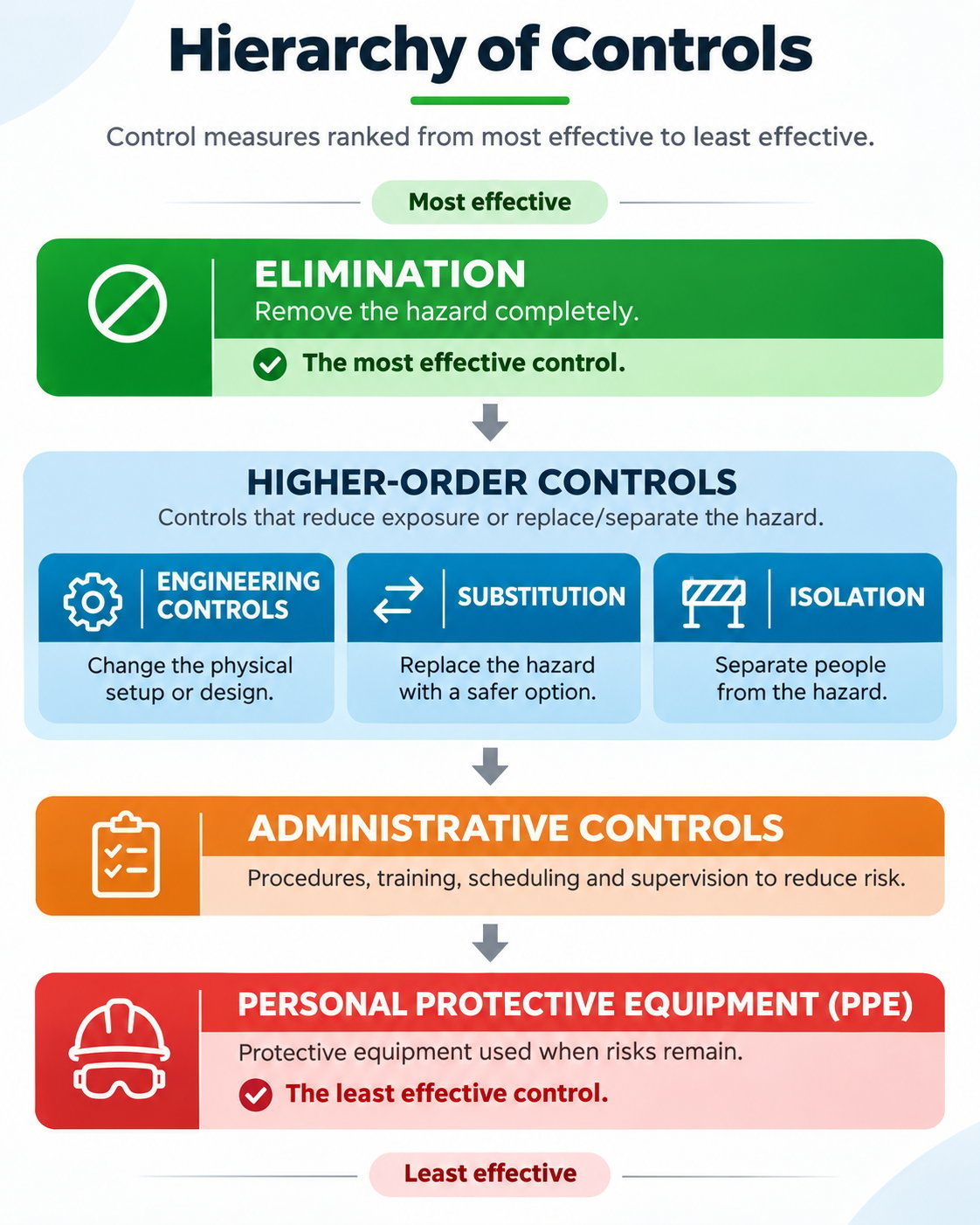
At Liberty, we connect those obligations to the equipment people actually use, and we apply the hierarchy of controls to manage risks as they arise - we eliminate, as often as we can, the electrical risk. We have a company environmental policy that states that our failed electrical equipment must be recycled as e-waste. Most wouldn't bother - they'd throw it all into landfull.

Test and Tag is an Administrative Control

Hierarchy of Controls diagram ranking safety measures from most effective (Elimination) to least effective (PPE), with Higher-Order Controls in between.

Before any of that: why are you calling?

A testing program should start with the problem that prompted it, not with a generic schedule. In practice, that problem varies:

  • An audit or certification review is approaching.
  • The previous provider's records didn't hold up to scrutiny.
  • A warehouse is turning up damaged equipment faster than it should.
  • Someone has taken on WHS responsibility and inherited an undocumented site.

That starting point shapes the scope, and it is where we begin.

1

Understand the Client's Obligations

What work is being performed? Who is using the equipment? What electrical hazards are foreseeable? Which legal and technical requirements apply?

These questions help establish the scope of the testing program.

2

Assess the Workplace and Its Risks

An office, warehouse, workshop and construction site present different operating conditions.

We work with the client to understand equipment use, exposure to moisture, dust, vibration, mechanical damage and other factors that may influence electrical safety.

The PCBU remains responsible for managing workplace risks. Our role is to contribute technical observations and inspection findings to that process.

3

Identify Hazards and Determine Suitable Controls

Test and tag supports the inspection, verification and administrative aspects of electrical risk management.

However, inspection and testing alone do not remove every hazard.

Identified risks may require equipment to be isolated, repaired, replaced or controlled through other measures.

The appropriate response depends on the nature of the hazard.

4

Inspect, Measure and Document

We visually inspect equipment, undertake the applicable electrical tests using calibrated instruments, identify unsafe items and record the results.

Measurements provide quantitative evidence of the equipment's condition at the time of testing.

Photographs, observations and recommendations provide additional context where appropriate.

5

Report, Recommend and Review

The compliance report brings the testing information together.

It provides records of what was inspected, the results obtained, equipment that failed and the next scheduled inspection or testing date.

Where relevant, we also provide recommendations to help the client address identified hazards.

What the client does with those findings is their decision. We don't take over the WHS system, but the report should give them enough to act on: reviewing whether existing controls still fit the way equipment is actually used, prioritising corrective actions, and deciding whether the current inspection and testing arrangements remain appropriate.

That is the difference between receiving a report and receiving information that supports ongoing risk management.

The process continues through future inspections and testing, with intervals determined by the applicable requirements and workplace risk.

This is what we mean by a compliance partnership: connecting legal obligations, practical inspection and testing, and documented evidence that helps a business manage electrical safety over time.

For more on the legislative framework, see Test and Tag and NSW Section 26A.

Why Do Photographs, Observations and Recorded Measurements Matter?

A compliance report needs to communicate more than whether equipment passed or failed.

A numerical measurement can establish the result of an electrical test.

A photograph can show the physical damage that prompted concern.

A written observation can explain where the equipment was being used, what was discovered and why further action was recommended.

These are different forms of evidence.

For a WHS manager, facilities manager or company director who wasn't present during testing, that additional information can help explain the decisions that need to follow.

Liberty provides digital compliance reports and asset registers containing asset information, results, identified failures and recorded measurements where applicable and according to the agreed testing package. How much is recorded per item varies between packages, so it is worth confirming which one your quotation is based on.

Where appropriate, we supplement that information with photographs, observations and recommendations.

This doesn't mean every report contains photographs or video of every appliance. It means we use these tools when they add useful evidence.

A measurement and an observation answer different questions

This is where the two forms of evidence earn their place together.

  • An insulation resistance measurement can identify an electrical defect that isn't externally visible.
  • A photograph of a damaged powerboard can illustrate a hazard that no measurement would describe.
  • Repeated damage across a site may point to a broader problem with equipment use, storage or protection — something only a pattern of observations reveals.

Together, those findings give the PCBU a more useful picture of its workplace than a pass or fail column on its own.

Standard or Premium: Two Levels of Data Capture

Liberty uses two testing systems. Both are used to perform applicable inspection and testing procedures in accordance with AS/NZS 3760:2022. The difference is how much information is captured and reported for each item — which is exactly the kind of distinction a quotation should make clear.

Neither option represents a lower standard of testing. They suit different workplaces and different reporting requirements.

Standard

Seaward PAC3760DL

Efficient, high-throughput testing suited to offices, retail, single-site environments and larger item counts where the priority is getting through a register methodically and consistently.

  • Visual inspection and applicable electrical tests to AS/NZS 3760:2022
  • Pass/fail results, tagging and asset records
  • Used where site requirements call for it, including some data-sensitive environments
Premium

Seaward PrimeTest Elite Pro

Maximum data capture and diagnostics per item. Suited to multi-site portfolios, complex or higher-risk environments, and workplaces that need deeper evidence behind each result.

  • Deeper recorded measurements per item, transferred into our reporting workflow after testing
  • Richer traceability for audits, insurers and ISO-style management systems
  • Better suited to diagnosing recurring faults across a site

When you compare quotations, ask which system the price is based on. A per-item rate means something different depending on how much is recorded, and that is a legitimate point of comparison rather than a reason to assume one provider is cutting corners.

Independent. Owner-Operated. Accountable.

Liberty Test & Tag is an independent, family-owned business. We are owner-operators, not a national franchise.

We don't pay franchise royalties or mandatory franchise marketing fees. We don't operate a network that allocates customers to different franchisees.

When you engage Liberty, you deal directly with the people responsible for carrying out the work.

Our reputation is built on our own inspections, our own reporting and our relationships with our clients.

We have worked within a franchise system. We know how it operates, what it does well and where the model can leave a customer dealing with a brand rather than the people doing the work. We chose to leave it and build something of our own.

That choice changes what is at stake for us. There is no national marketing budget sending work our way. Our own reputation determines whether a client returns, recommends us to another site, or trusts us with the next contract.

A recognisable brand name or prominent sponsored advertisement can make a provider easier to find. But it doesn't, by itself, establish the competence of the technician who attends your workplace or the quality of the testing and documentation you'll receive.

We have to earn our reputation through the work we do — and because we have been on the other side of that model, we know what we are choosing not to rely on.

That means taking the time to identify problems, explain our findings, provide useful evidence and demonstrate value beyond the minimum testing schedule.

We want clients to engage us again because they know how we work, what we deliver and who is accountable.

We're not paying for a franchise. We're investing in the service.

How to Compare Commercial Test & Tag Quotes

Before choosing a contractor, compare what each quotation actually provides.

What to compare What to ask
Electrical testing Which procedures and measurements will be performed?
Technician competency Who will attend the site, and what training and experience do they have?
Equipment and instruments Are the instruments suitable and calibrated?
Testing package Which level of data capture is the price based on, and how much is recorded per item?
Failed equipment How are defects identified, communicated and recorded?
Additional observations Will hazards outside the scheduled test list be brought to our attention?
Evidence Are measured results, photographs and recommendations available where relevant?
Reporting What information is included in the final asset register and compliance report?
Additional services Can RCD, three-phase and other applicable inspections be coordinated?
Accountability Who is responsible for the work, reports and follow-up enquiries?
Total cost What are the site attendance, per-item and specialist testing charges?

A lower price doesn't automatically mean poor testing. A higher price doesn't guarantee better testing.

The question is whether the proposed service meets your workplace's actual requirements and provides useful evidence of the work completed.

How Much Does Commercial Test & Tag Cost in Sydney?

Liberty Test & Tag applies a $90 site attendance and reporting fee, with per-item testing charged according to the agreed scope.

Per-item pricing depends on two things: the volume of items tested and the testing package used. Larger registers attract a lower per-item rate, and there are two levels of data capture — standard and premium — which are priced differently because they record different amounts of information per item.

Two other things shape the total. Jobs under 30 items are priced as a single job minimum of $150 + GST, which covers site attendance and reporting as well as the testing itself. And the attendance and reporting fee is not a fixed add-on: it applies in full on smaller jobs, reduces as the item subtotal grows and is waived entirely at higher volumes, so it is not quietly built back into the per-item rate.

Because the rate moves with volume and package, publishing a single figure here would be misleading. Our Test & Tag Cost Calculator applies the current rates to your actual circumstances.

The actual quotation depends on the equipment count, testing requirements, workplace conditions, site access and job size. Specialist equipment can be priced differently.

Three-phase testing and RCD safety switch testing are considered separately where applicable.

The site attendance fee helps cover the costs of providing an onsite professional service, including travel, setup and compliance reporting.

We provide clear quotations so customers can understand what has been included before work begins.

For an indicative estimate, use our Test & Tag Cost Calculator.

$90

Site attendance and reporting fee (ex GST), covering travel, setup and compliance reporting. It reduces at higher item volumes and is waived entirely on larger jobs.

Volume and package

Per-item rates step down as the item count rises, and standard or premium packaging changes the rate because it changes how much is recorded. Use the calculator for current figures (ex GST).

Commercial Test & Tag Sydney — Choose Value, Not Just Price

Liberty Test & Tag provides electrical testing, RCD testing, three-phase equipment testing, emergency and exit lighting inspections, and fire equipment servicing for commercial workplaces across Sydney.

We're independent, family-owned and directly accountable for the work we perform.

We provide measured results, digital compliance reporting, practical observations and recommendations to help clients understand the electrical risks identified during testing.

Our objective is to build long-term relationships with businesses that value competent testing, reliable documentation and professional service.

Need more from your test and tag contractor than an attractive price per item?

Commercial Test & Tag Pricing in Sydney — Frequently Asked Questions

NSW Regulatory References

Liberty Test & Tag

Liberty Test & Tag provides electrical safety testing and compliance services across NSW and the ACT. We deliver structured inspection, testing, and reporting aligned with Australian Standards, supporting businesses with clear, traceable records for audits, insurers, and regulatory requirements.

info@libertytestandtag.com.au