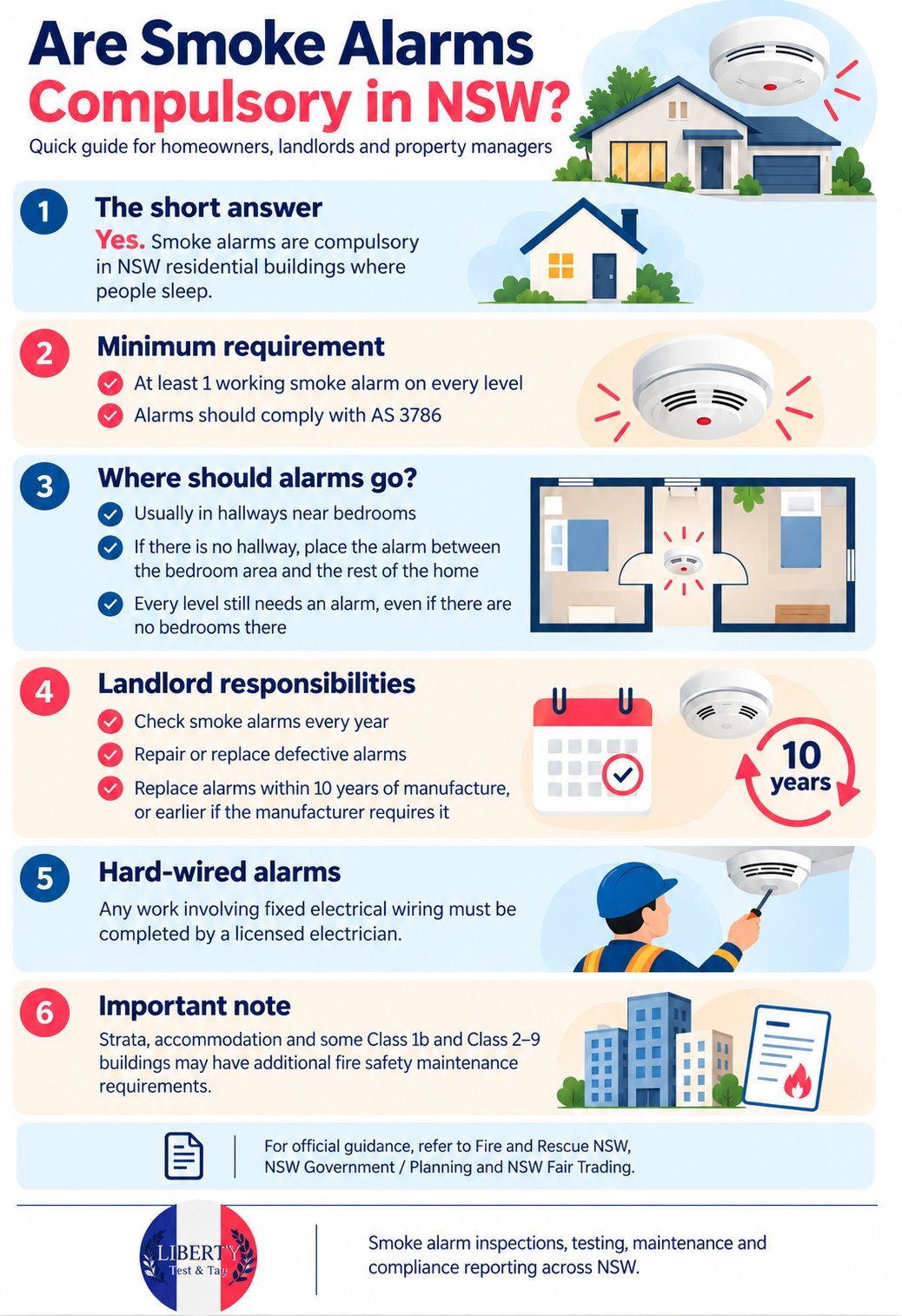
Yes — smoke alarms are compulsory in NSW residential buildings where people sleep. As a minimum, at least one working smoke alarm complying with AS 3786 must be installed on every level of the premises.
There is not a new blanket NSW smoke alarm law beginning in 2027.
The existing NSW requirements continue to apply.
Smoke alarms are required in residential buildings where people sleep, and at least one working alarm must be installed on every level. Smoke alarms must comply with the applicable requirements of AS 3786.
For some strata, accommodation and other Class 1b and Class 2–9 buildings, broader NSW fire safety maintenance requirements may also apply to essential fire safety measures.
Changes that commenced in February 2026 strengthened the use of AS 1851-2012 for the routine inspection and testing of applicable essential fire safety measures.
The requirements therefore depend partly on the type of building and how it is used.
For an existing NSW home, the minimum requirement is generally at least one working smoke alarm on every level.
That includes levels where there are no bedrooms.
Where bedrooms are located in different parts of the property, additional alarms may be required to provide the required coverage.
Fire and Rescue NSW also recommends greater protection than the minimum legal requirement, including additional alarms in areas such as bedrooms and living areas.
Smoke alarms are generally installed in hallways associated with bedrooms.
If there is no hallway, the alarm should be located between the part of the home containing the bedrooms and the remainder of the dwelling.
Where bedrooms are located in separate areas, alarms may be needed in each relevant part of the property.
Every level of the home must still have a smoke alarm, even where no bedrooms are located on that level.
The answer depends on the property.
Homeowners should regularly test and maintain their smoke alarms in accordance with manufacturer guidance and Fire and Rescue NSW recommendations.
For NSW rental properties, landlords and managing agents must check smoke alarms every year to ensure they are working.
Different inspection and maintenance requirements may apply to strata buildings, accommodation premises and other buildings where smoke alarms form part of the building's essential fire safety measures.
This is why the building type and fire safety requirements should be identified rather than applying the same maintenance schedule to every property.
Yes. Smoke alarms have a limited service life.
For NSW rental properties, landlords must ensure smoke alarms are replaced within 10 years of their manufacture date, or earlier where the manufacturer specifies a shorter service life.
The manufacture or expiry information should therefore form part of a proper smoke alarm inspection.
An alarm can still respond when its test button is pressed while being at or beyond its recommended service life.
NSW landlords and managing agents are responsible for ensuring smoke alarms installed in rental properties are in working order.
They must:
Tenants also have responsibilities, including notifying the landlord or managing agent when they become aware that a smoke alarm is not working.
Any work involving fixed electrical wiring must be completed by a licensed electrician.
Where an alarm can be replaced without altering fixed electrical wiring, this may not involve electrical wiring work. However, the installation method must be assessed correctly.
Liberty does not perform fixed electrical wiring work. Where licensed electrical work is required, it must be completed by a licensed electrician.
AS 1851 deals with the routine service of fire protection systems and equipment.
From 13 February 2026, NSW introduced requirements for applicable essential fire safety measures in Class 1b and Class 2–9 buildings to be inspected and tested in accordance with AS 1851-2012, subject to the applicable building requirements and any approved alternative arrangements.
This is particularly relevant to strata, accommodation, commercial and other buildings containing essential fire safety measures.
A normal private home is not automatically subject to the same fire safety maintenance framework as a commercial, strata or accommodation building.
Smoke alarm requirements still apply when a NSW residential property is being sold.
A residential building where people sleep must have the smoke alarms required under NSW law, regardless of whether the property is being occupied, rented or prepared for sale.
Before a property changes hands, owners should make sure the required alarms are installed, operational and compliant. Smoke alarm requirements are not something that only applies to occupied homes.
Smoke alarm requirements can become more complex in strata buildings, motels, boarding houses, holiday accommodation and other properties where people sleep.
The requirements may depend on:
These properties should not simply be treated as ordinary private homes. Where an AFSS applies, smoke alarms may form part of the wider inspection and fire safety compliance process.
A smoke alarm inspection should involve more than simply pressing the test button.
Depending on the alarm and property, Liberty can inspect and record:
Liberty can also clean alarms, replace appropriate batteries and install or replace suitable smoke alarms where fixed electrical wiring work is not required.
Any work involving fixed electrical wiring must be completed by a licensed electrician.
For landlords, strata managers, accommodation providers and property managers, documentation can be just as important as the inspection itself.
Liberty provides digital smoke alarm compliance reports that can record each alarm individually, including:
This provides a traceable record of the alarms inspected at the property and their condition at the time of inspection.
For up-to-date official guidance, see:
Liberty Test & Tag provides smoke alarm inspection, testing, maintenance and compliance reporting for landlords, strata, accommodation providers and other managed properties across NSW.
We can also assist businesses and property managers with broader fire equipment inspections and AFSS coordination where required. We also provide smoke alarm inspections in Sydney and across Lithgow and Greater NSW.