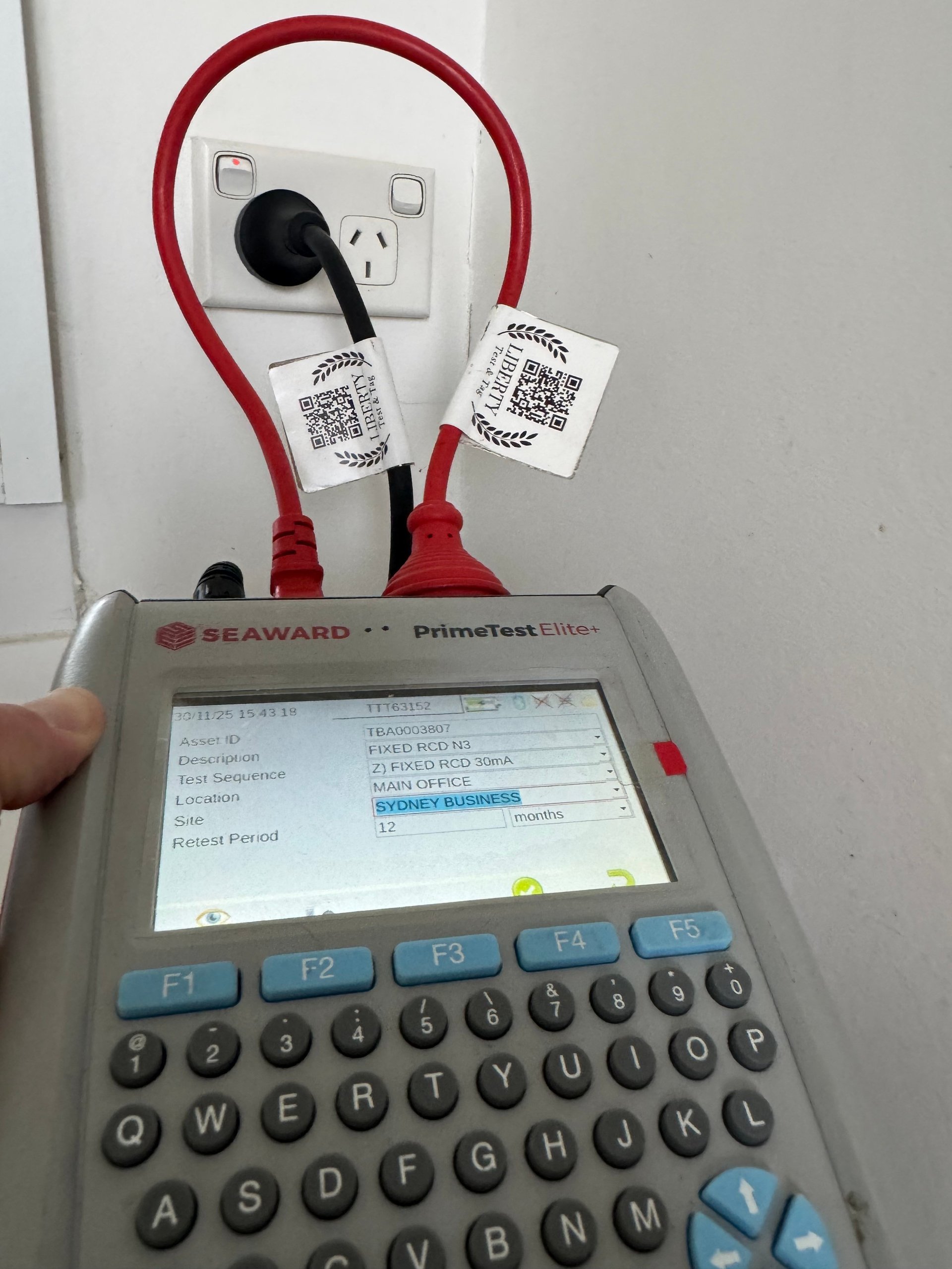
SEAWARD PrimeTest Elite electrical testing device connected to a wall outlet with red cables and QR code labels
Test & Tag Guide

What Is RCD Testing?

Published 13 November 2026 14 min read

Short Answer

RCD testing checks whether a Residual Current Device (RCD), commonly called a safety switch, disconnects the electricity supply within the required time when a residual current fault is simulated.

A competent technician uses specialised equipment to measure the RCD's trip time in milliseconds (ms), comparing the result against AS/NZS 3760:2022.

In NSW, section 165 of the Work Health and Safety Regulation 2025 requires regular workplace RCD testing by a competent person.

Liberty Test & Tag provides fixed and portable RCD testing for factories, warehouses, offices, schools and construction sites across Sydney and NSW. We record actual trip-time measurements and provide digital compliance reports.

How Does an RCD Work?

An RCD monitors the electrical current flowing through the active and neutral conductors. Under normal conditions, the current leaving through the active conductor returns through the neutral conductor.

If some current takes another path, such as through damaged equipment or a person to earth, the RCD detects the imbalance and disconnects the electricity supply when its operating threshold is reached.

For example, if 10 amps goes out, 10 amps must also come back in.

If the returning current is lower, some of that electricity is going somewhere else.

General-purpose personal protection RCDs commonly have a rated residual operating current of 30 milliamps (30 mA). More sensitive 10 mA devices are used for particular applications.

RCDs significantly reduce the risk of serious electric shock, but they cannot prevent every electrical injury. For example, contact with both active and neutral conductors may not create the imbalance required to trip an RCD.

They also contain components that can deteriorate or fail. An installed safety switch cannot simply be assumed to be functioning correctly.

It is not enough to assume that office equipment does not need inspection and testing because it is protected by an RCBO (a type of safety switch). An RCBO provides protection against particular electrical faults, but it does not establish whether an appliance, power board or extension lead is electrically safe.

30 mA

General-purpose personal protection RCDs commonly rated here.

10 mA

More sensitive devices used for particular applications.
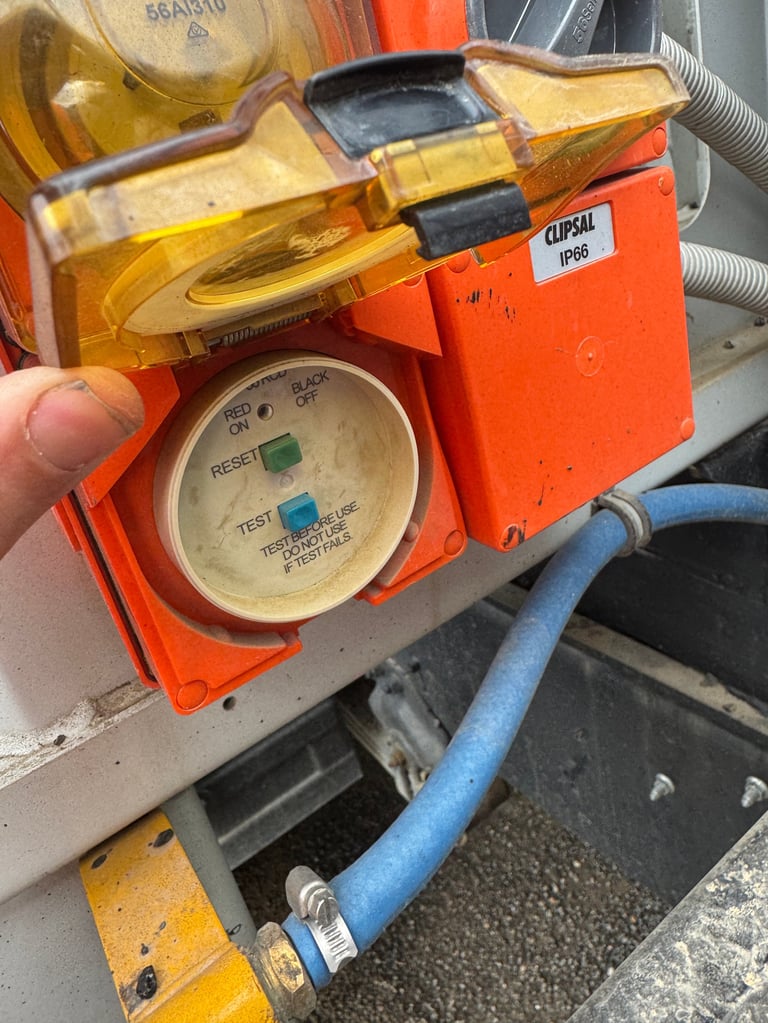
Orange Clipsal IP66 residual current device with yellow flip cover open, showing red OFF, green RESET, and blue TEST buttons, held by a finger
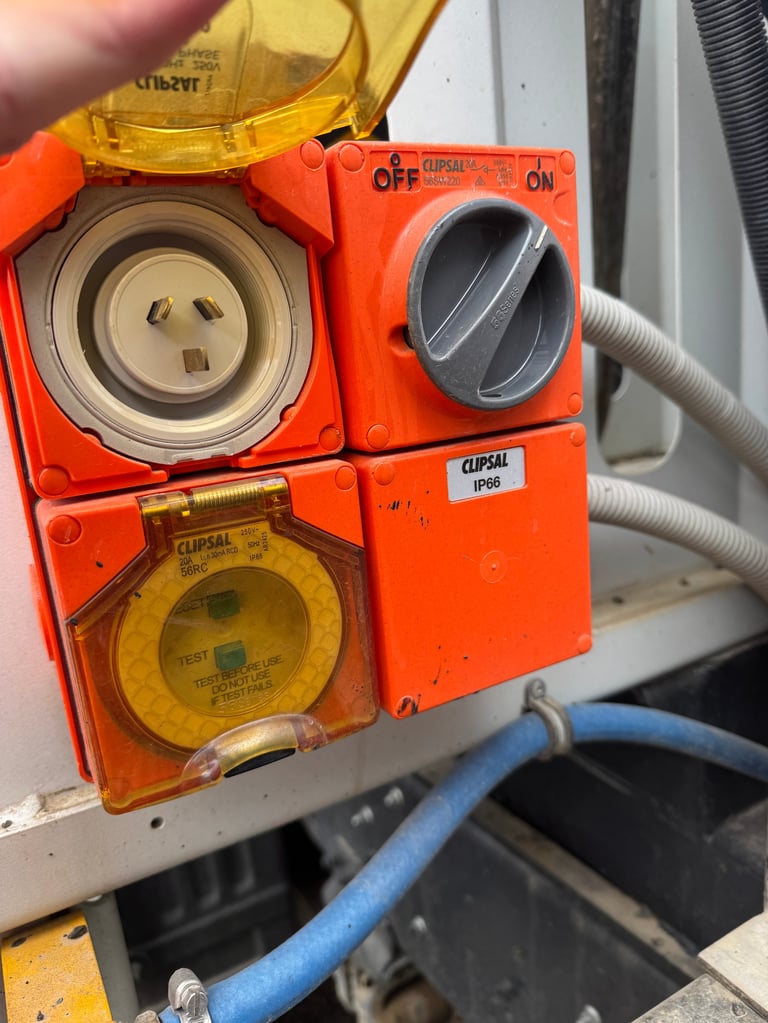
Orange Clipsal IP66 industrial power outlet with a grey OFF/ON rotary switch, a 3-pin socket, and a yellow test cover, mounted on a metal panel

What Are the Different Types of Electrical Safety Switches and Circuit Breakers?

Electrical protection differs between homes, commercial buildings, workshops and three-phase industrial installations.

Device What it does Where commonly found
MCB — Miniature Circuit Breaker Protects electrical circuits against overloads and short circuits. Does not independently provide residual-current protection. Homes, offices, workshops and commercial switchboards.
RCCB — Residual Current Circuit Breaker (a type of RCD) Detects residual current imbalance and disconnects the circuit. Requires separate overcurrent protection. Homes, schools, offices, factories and commercial buildings.
RCBO — Residual Current Circuit Breaker with Overcurrent Protection Combines residual-current protection with overload and short-circuit protection. Modern domestic switchboards, offices, commercial premises and industrial installations.
MCCB — Moulded Case Circuit Breaker Provides higher-capacity circuit protection, commonly in commercial and industrial switchboards. Residual-current protection depends on the configuration. Factories, warehouses, large commercial buildings and industrial switchboards.
Portable RCD Provides residual-current protection for connected equipment, including power tools, extension leads and portable power distribution equipment. Construction sites, workshops, factories, maintenance operations and temporary worksites.

What About Three-Phase Equipment?

Factories and industrial facilities may use three-phase circuits with multi-pole RCDs, RCBOs or other protective arrangements.

RCDs are also classified by the forms of residual current they can detect. For example, Type A and Type B devices have different detection capabilities. These should not be confused with the Type I and Type II classifications based on residual operating current and trip-time requirements.

The appropriate protective device depends on the installation and equipment. Selection, installation and modification of switchboard protection are matters for a licensed electrician.

An RCBO combines two protective functions, but it does not eliminate every electrical hazard or remove the need for testing.

What Does an RCD Test Check For?

RCD testing establishes whether the device operates when required and, through instrument testing, how quickly it disconnects the electricity supply.

Two tests are particularly important:

1

Push-Button Testing

Pressing the RCD's test button activates its internal test mechanism. This confirms that the device responds to the manual test, but does not measure its actual trip time.

2

Operating-Time (Trip-Time) Testing

A specialised electrical instrument applies a controlled residual test current and measures the time taken for the RCD to disconnect power.

The result is recorded in milliseconds (ms).

For example, a recorded operating time of 24 ms means the device disconnected in 0.024 seconds under the applied test conditions.

Under AS/NZS 3760:2022, different RCD classifications have different operating-time requirements. A standard 30 mA Type II RCD has a maximum operating time of 300 ms at the specified test current. A 10 mA Type I RCD has a maximum operating time of 40 ms.

30 mA Type II RCD

300 ms

Maximum operating time at the specified test current.

10 mA Type I RCD

40 ms

Maximum operating time at the specified test current.

This is important to understand: two RCDs may both pass while recording significantly different operating times.

At Liberty Test & Tag, we use Seaward testing instruments to measure RCD operating times at both 0° and 180° phase angles. The equipment records the measured trip times electronically, and we also record the results on the test tags.

We frequently perform measured operating-time testing alongside portable RCD checks rather than relying on the push button alone.

How Are Fixed and Portable RCDs Tested?

Portable RCDs

Include standalone safety switches, protected power boards and portable distribution equipment. They can be inspected and tested using appropriate instrument procedures for the device.

Fixed RCDs

Protect circuits within an electrical installation, commonly from a switchboard.

Liberty tests suitable fixed RCD-protected circuits through accessible general-purpose power outlets (GPOs), rather than conducting tests inside switchboards.

Testing at a GPO requires the relevant protected circuit and device to be identified. Where direct switchboard testing, installation work, repairs or electrical fault-finding are required, that work belongs with a licensed electrician.

Because trip-time testing disconnects power, testing must be coordinated to avoid disruption to computers, equipment and business operations.

For sites with multiple fixed RCDs, access to the relevant switchboards for resetting devices may also be required.

Is RCD Testing Mandatory in Australia?

Yes, regular RCD testing is legally required in applicable Australian workplaces, although the detailed requirements differ between states and territories.

In NSW, section 165 of the Work Health and Safety Regulation 2025 requires a person with management or control of a workplace to take all reasonable steps to ensure RCDs used at that workplace are regularly tested by a competent person.

Section 164 also requires appropriate RCD protection, so far as reasonably practicable, in specified higher-risk operating environments. Examples include equipment exposed to moisture, dust, vibration, mechanical damage or frequent movement.

These requirements apply to workplace electrical risk management, not simply to whether a safety switch has been installed.

Responsibilities of Business Owners and Workplace Managers

A Person Conducting a Business or Undertaking (PCBU) must manage electrical risks and ensure applicable safety controls are maintained.

For RCDs, this includes arranging appropriate testing and keeping required testing records until the device is next tested or permanently removed from use. The regulation excludes daily testing from this record-retention requirement.

Since 1 July 2026, section 26A of the Work Health and Safety Act 2011 also requires NSW businesses to comply with applicable approved Codes of Practice or manage the relevant risks through an alternative providing an equivalent or higher standard of safety.

For electrical risk, the Managing Electrical Risks in the Workplace Code of Practice provides guidance about RCD selection, use, limitations and testing.

A workplace with RCDs but no reliable record of their testing should review whether its electrical safety obligations are being met.

Liberty provides measured test results and digital records to support workplace electrical compliance programs.

How Often Should RCDs Be Tested?

RCD testing intervals depend on the workplace environment, whether the device is fixed or portable, and the applicable Australian Standard.

AS/NZS 3760:2022 provides indicative testing frequencies for general workplaces, including separate intervals for push-button checks and measured operating-time tests.

Examples include:

Workplace Portable RCDs Fixed RCDs
Factories and workshops Push-button: daily or before each use. Measured trip-time: 12 months. Push-button: 6 months. Measured trip-time: 12 months.
Offices and lower-risk commercial areas Push-button: 3 months. Measured trip-time: 24 months where low-risk conditions apply. Push-button: 6 months. Measured trip-time: 24 months where low-risk conditions apply.
Construction and demolition sites Push-button: before each use. Measured trip-time: 3 months. Push-button: monthly. Measured trip-time: 12 months.

Construction sites also require portable RCD push-button checks before each use and monthly push-button checks for fixed RCDs under AS/NZS 3012:2019.

These are not universal intervals. Site conditions, equipment types and applicable risk controls must be considered.

Where businesses operate across multiple sites, maintaining a consistent testing schedule and accessible records helps prevent overdue inspections.

How Long Does an RCD Test Take?

An individual RCD trip-time measurement takes milliseconds once initiated, but the complete inspection and testing process takes longer.

A portable RCD can take a few minutes to inspect and test. Fixed RCDs generally take longer.

For fixed RCD testing, having two technicians is often the most practical arrangement. One tests from the GPO or power point while the other accesses the switchboard to reset the RCD after it trips.

The total time also depends on the number of devices, circuit identification, accessibility and the need to disconnect and restore power.

Portable RCD testing can often be incorporated into a routine electrical test and tag visit.

For factories, warehouses and other operational workplaces, testing should be planned around equipment use to minimise unnecessary downtime.

How Much Does RCD Testing Cost?

RCD testing prices depend on the number and type of devices, site conditions and access requirements.

Liberty Test & Tag generally includes routine portable RCD testing within our standard electrical test and tag service, rather than automatically charging a separate $15–$25 fee for each portable safety switch.

Some surge-protected power boards can take just as long to test as a portable RCD, and we do not automatically charge an additional fee for those either.

Fixed RCD testing may attract an additional charge because of the extra time and personnel required to test and reset devices.

For workplaces with multiple RCDs, portable appliances, three-phase equipment or several compliance requirements, testing can be coordinated into a single visit.

We provide clear quotations based on the work required rather than applying unnecessary per-device charges.

Need RCD testing for a factory, warehouse, school, office or construction site? Contact Liberty for a commercial quotation.

What Happens if an RCD Fails Testing?

An RCD may fail because it does not trip, operates outside the applicable time limit, or otherwise fails to perform correctly.

A failed device must not be relied upon for its intended protection.

The fault should be documented, the relevant equipment or circuit made safe, and a licensed electrician engaged where fixed electrical installation work or replacement is necessary.

Liberty records failed results and identifies the affected device in its testing documentation.

A faulty RCD should not be returned to service until the necessary corrective action and verification have been completed.

Sydney & NSW

Book Commercial RCD Testing in Sydney and NSW

Liberty Test & Tag is an independent, family-owned electrical safety testing business based in Campbelltown, servicing Sydney, Western Sydney, the Illawarra and regional NSW.

Fixed and portable RCD testing
Recorded trip-time measurements
Electrical test and tag services
Three-phase equipment testing
Digital compliance reports and asset records
Coordinated workplace testing to minimise operational disruption

Our technicians work directly with businesses, facilities managers, contractors and workplace safety personnel. No franchise call centres.

If your workplace RCD testing is overdue, your records are incomplete, or you need testing included in a broader electrical compliance visit, contact Liberty Test & Tag.

Electrical compliance done properly.

Authoritative References

Liberty Test & Tag provides electrical safety testing and compliance services across NSW and the ACT. We deliver structured inspection, testing, and reporting aligned with Australian Standards, supporting businesses with clear, traceable records for audits, insurers, and regulatory requirements.

info@libertytestandtag.com.au