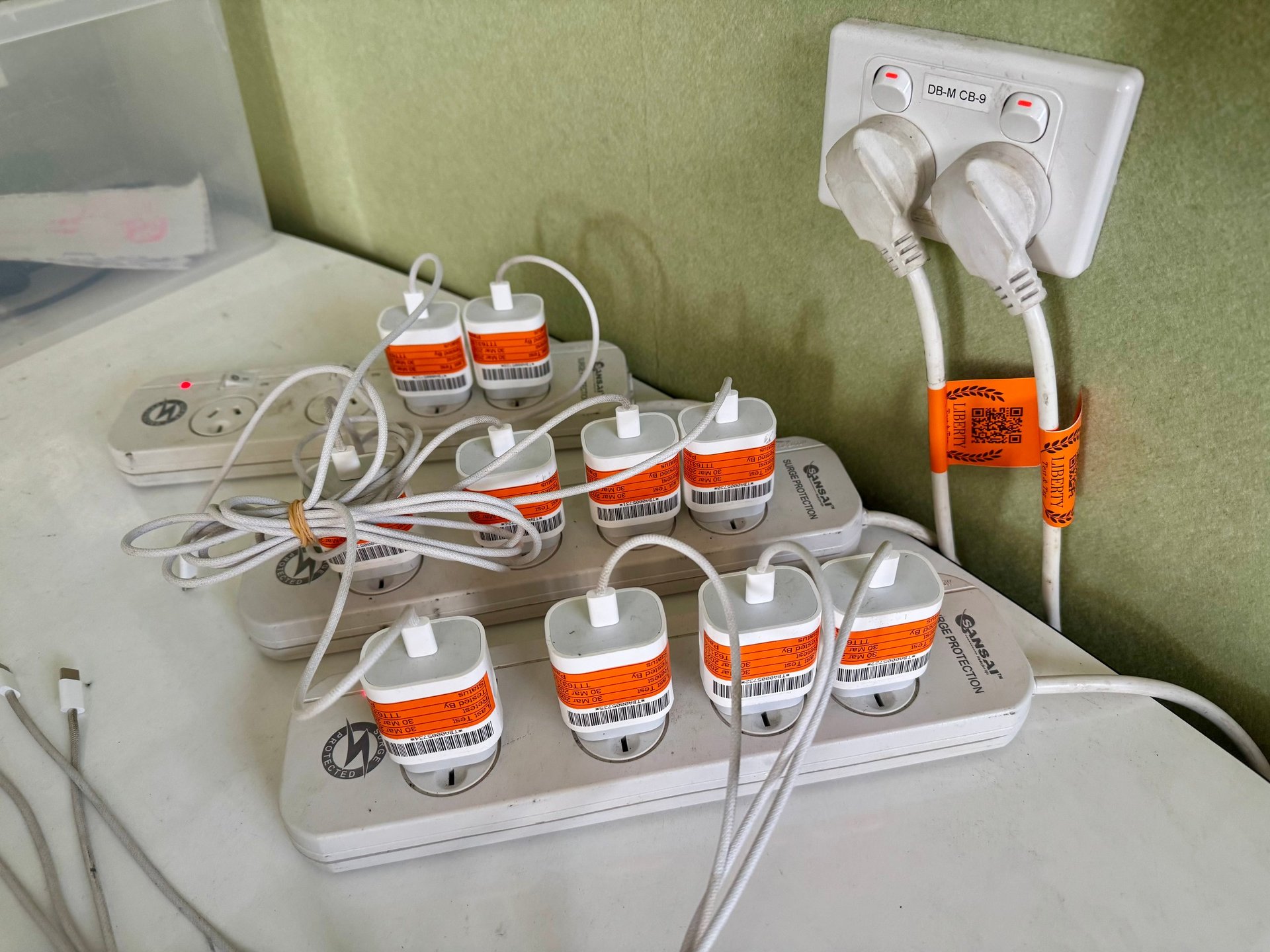
Yes — test and tag is still required in NSW workplaces where electrical equipment presents a risk, but it is not a standalone legal requirement. Instead, it forms part of a business's duty under the Work Health and Safety Regulation 2025 (NSW) to ensure electrical equipment is safe and inspected and tested as necessary. In practice, compliance is commonly demonstrated by following AS/NZS 3760:2022, which provides the recognised method for inspecting, testing, and documenting portable electrical equipment.
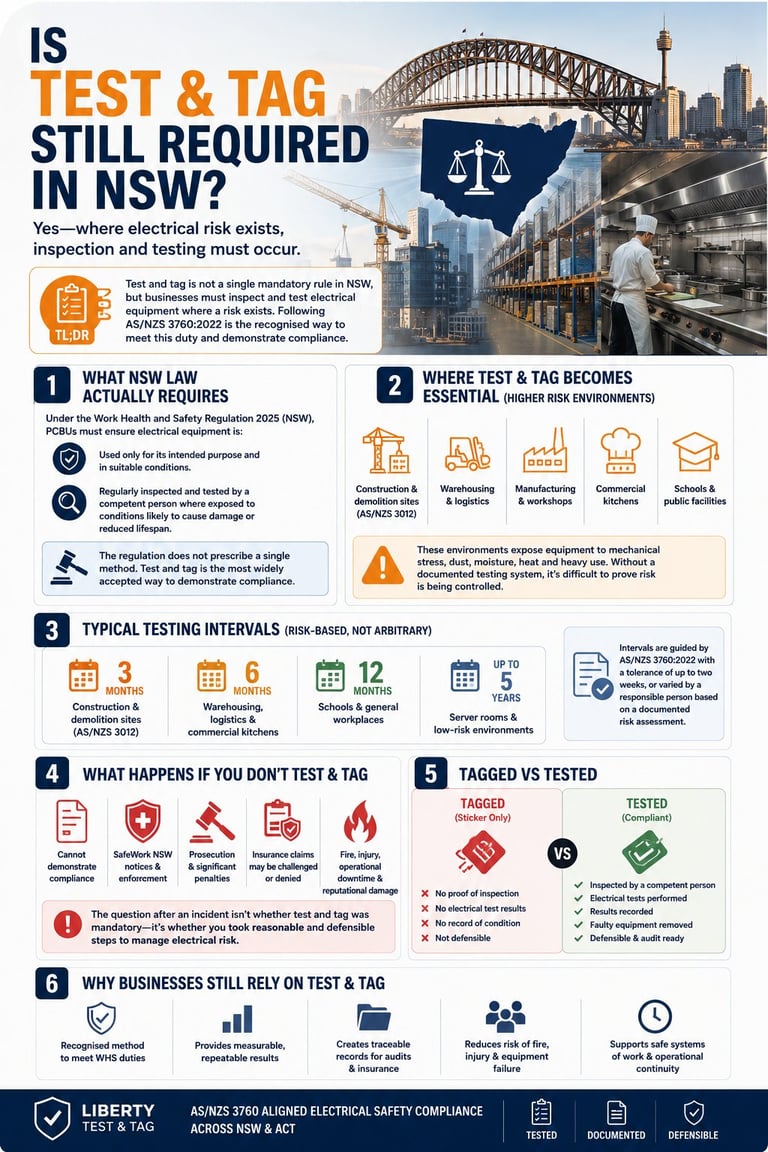
What the Law Actually Requires in NSW
In NSW, electrical safety is governed by the Work Health and Safety Act 2011 and the Work Health and Safety Regulation 2025.
Clause 150 requires a Person Conducting a Business or Undertaking (PCBU) to ensure that electrical equipment is:
- Used only for its intended purpose and in suitable conditions
- Regularly inspected and tested by a competent person where the equipment is exposed to conditions likely to result in damage or reduced lifespan — including moisture, heat, dust, vibration, mechanical damage, or corrosive substances
The regulation does not prescribe a single method such as "test and tag." Instead, it requires regular inspection and testing of at-risk equipment by a competent person.
Test and tag is the most widely accepted way to demonstrate that this duty has been met.
Why Test and Tag Is Still Required
Although not written as a single mandatory rule, test and tag remains the industry standard method of compliance because it provides:
- A structured inspection process
- Measurable electrical test results
- Clear identification of tested equipment
- Documented evidence for audits and inspections
Following test and tag per AS/NZS 3760:2022 gives businesses a recognised framework that aligns with WHS duties and can be relied on if compliance is questioned.
This is why regulators, insurers, and auditors expect to see it in place.
When Test and Tag Is Effectively Required
Outside of workplace environments, these requirements are often misunderstood — particularly in residential settings such as rental properties or short-term accommodation.
In many NSW workplaces, test and tag becomes effectively mandatory in practice due to risk level.
This includes:
- Construction and demolition sites (AS/NZS 3012)
- Warehousing and logistics environments
- Manufacturing and workshops
- Commercial kitchens
- Schools and public facilities
In these environments, electrical equipment is exposed to:
- Mechanical stress
- Dust and contamination
- Moisture or cleaning processes
- Heat and heavy use
Without a documented testing system, it is difficult to demonstrate that risks are being controlled.
How do you know your worksite is safe? Liberty provides AS/NZS 3760 testing, clear digital reports and minimal disruption across NSW and ACT.
Testing Frequencies (Risk-Based, Not Arbitrary)
Testing intervals are not set by legislation. They are determined by risk, with guidance provided by AS/NZS 3760:2022.
Typical intervals include:
- Construction and demolition sites → 3 months (as aligned with AS/NZS 3012)
- Warehousing, logistics, and commercial kitchens → 6 months
- Schools and general workplaces → 12 months
- Server rooms and low-risk environments → up to 5 years
AS/NZS 3760 allows these intervals to be applied with a tolerance of up to two weeks, or varied by a responsible person based on a documented risk assessment.
Extending intervals beyond standard guidance requires a documented risk assessment, particularly where businesses operate under ISO or formal compliance frameworks.
The key principle is not the interval itself, but whether it is justifiable based on the level of risk and supported by evidence.
When Test and Tag May Not Be Regularly Required
In very low-risk environments, such as server rooms or cabinets where portable electrical equipment is never disturbed and the temperature is constantly regulated.
However, PCBUs must still:
- Inspect equipment
- Identify faults
- Maintain safe systems of work
If an incident occurs, the question is not whether test and tag was mandatory.
It is whether the business took reasonable and defensible steps to manage electrical risk.
What Happens If You Don't Test and Tag
If electrical equipment causes injury, fire, or damage, and there is no evidence of inspection or testing:
- The PCBU may be unable to demonstrate compliance
- SafeWork NSW may issue improvement or prohibition notices
- Prosecution and significant penalties may apply
- Insurance claims may be challenged or denied
SafeWork NSW publishes enforcement outcomes, including fines and prosecutions, where businesses have failed to manage electrical risks appropriately.
The consequences extend beyond fines:
- Operational downtime
- Reputational damage
- Injury or loss of life
This is why test and tag is widely adopted — it creates a defensible compliance position. For a detailed analysis of the legal framework, including Clause 150, penalties, and practical compliance steps, see our full guide: Is test and tag a legal requirement in NSW?
Electrical safety isn't just about tagging — it's about having defensible records. If you're unsure where your current system stands, we can review it.
The Difference Between "Tagged" and "Tested"
A tag on its own does not demonstrate compliance.
Compliance requires:
- Proper inspection
- Correct electrical testing
- Recorded results
- Removal of unsafe equipment
There is a clear distinction between:
- Equipment that has been labelled
- Equipment that has been tested and verified safe and compliant under AS/NZS 3760
This distinction becomes critical during audits, investigations, and insurance reviews.
Why Businesses Still Rely on Test and Tag
Test and tag is done because it is the recognised way that companies and organisations prove how they are compliant with NSW WHS legislation in providing a workplace environment that is safe for their employees and clients from foreseeable electrical risks.
- A repeatable system
- Traceable records
- Clear evidence of action
- Alignment with recognised standards
It is not just a process — it is a way of demonstrating that electrical safety is being actively managed.
Stay compliant, protect your staff, and keep defensible records. Speak with Liberty about scheduled Test & Tag, RCD testing and full electrical compliance support.
Summary
Test and tag is still required in NSW — not as a single mandated rule, but as part of a broader legal obligation to ensure electrical equipment is safe.
Where electrical risk exists, inspection and testing must occur.
In practice, following AS/NZS 3760 is the most recognised and defensible way to meet that obligation.
For workplaces where RCD safety switches protect circuits supplying portable equipment, regular RCD testing forms part of the same compliance framework — ensuring both the devices and the circuits they protect remain safe.
For businesses requiring compliant inspection and testing, see our test and tag Sydney service.
Liberty Test & Tag provides electrical safety testing and compliance services across NSW and the ACT. We deliver structured inspection, testing, and reporting aligned with Australian Standards, supporting businesses with clear, traceable records for audits, insurers, and regulatory requirements.