If you are seeking to have a 5-year retest period on all of your electrical equipment, regardless of electrical risk, we may not be a good fit for you.
TL;DR
It sounds like a question that should have a simple answer. 12 months for an office. 6 months for a warehouse or workshop. 3 months for construction.
AS/NZS 3760:2022 provides indicative inspection and testing intervals for different types of equipment and operating environments, set out in Table 2.4 – Indicative testing and inspection intervals for electrical equipment. These intervals are a good starting point, but the standard includes a caution directly beneath that table: it must be read in conjunction with AS/NZS 3760 as a whole, particularly Section 2.2 – Frequency of inspection and tests.
In other words, the table cannot be read on its own – not just one table! Section 2.2 is where the frequency of inspection and testing is actually determined, and Table 2.4 is a baseline applied through that process.
However, there is a huge problem with just picking an interval because it's in a table.
Electrical equipment is used by people. And people change the risk.
They move equipment. Add powerboards. Replace chargers. Reconfigure desks. Piggyback leads. Spill coffee on surge powerboards. Block ventilation on computers. Introduce equipment from home that wasn't there when the last inspection was completed.
The people factor is particularly important when considering longer inspection and testing intervals.
Before we get into why, let's answer the question most businesses want answered.
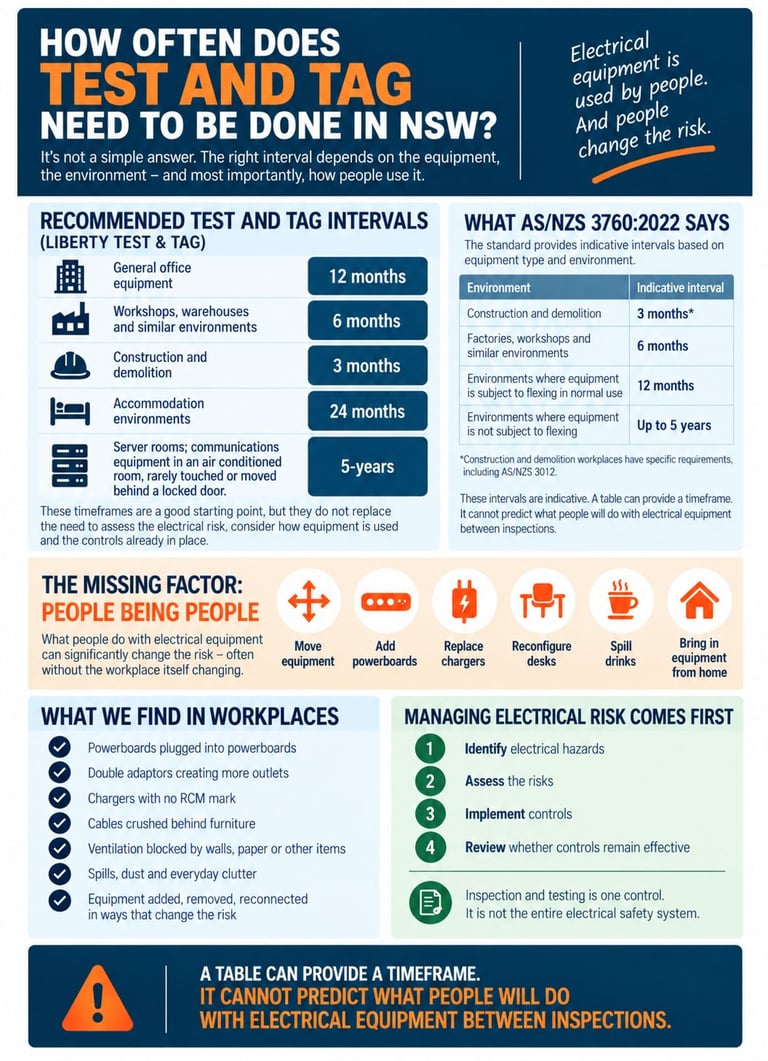
If you are looking for a practical and defensible testing schedule, Liberty Test & Tag recommends the following as a starting point:
| Workplace / equipment | Recommended interval |
|---|---|
| General office equipment | 12 months |
| Workshops, warehouses and similar environments | 6 months |
| Construction and demolition | 3 months |
| Accommodation environments | 24 months |
| Server rooms; communications equipment that sits in an air conditioned room and is rarely touched or moved behind a locked door. | 5-years |
These recommendations are based on the indicative intervals in Table 2.4 of AS/NZS 3760:2022, adjusted according to the risk we assess at each site. As the standard's own caution notes, Table 2.4 must be read in conjunction with AS/NZS 3760 as a whole — particularly Section 2.2, Frequency of inspection and tests. The table provides the baseline; Section 2.2 governs how it is applied.
These timeframes provide a good starting point for managing electrical risk, but they do not replace the need to assess the electrical risk; consider the equipment, how it is used and the controls already in place.
Liberty does not automatically recommend a 5-year interval simply because equipment is located in an office. Far from it.
5-years is better reserved for equipment where the circumstances genuinely support it, such as protected server or communications equipment that remains stationary, is rarely handled and is subject to effective controls.
For a typical office, we consider 12 months a more defensible starting point because it recognises a factor that testing tables cannot predict: what people do with electrical gear under their desks.
Table 2.4 of AS/NZS 3760:2022 sets out indicative inspection and testing intervals based on the type of equipment and the environment in which it is used. A selection of the environment-based intervals is shown below — the standard should be consulted for the table in full.
Some of the environmental examples include:
| Environment | Indicative interval |
|---|---|
| Construction and demolition | 3 months* |
| Factories, workshops and similar environments | 6 months |
| Environments where equipment is subject to flexing in normal use | 12 months |
| Environments where equipment is not subject to flexing | Up to 5-years |
| Accommodation environments | 2 years |
* Construction and demolition workplaces have specific requirements, including AS/NZS 3012.
Table 2.4 also covers intervals by equipment circumstance rather than environment alone. Equipment that has been repaired or serviced, hired, or acquired second-hand is treated differently again — because what has happened to an item already changes its risk, no matter where it sits. This is the same principle at work throughout this article: the circumstance, not just the location, determines the appropriate interval.
The important word here is indicative.
A table can provide a timeframe. It cannot predict what people will do with electrical equipment between inspections.
Electrical equipment does not remain frozen in time after somebody puts a tag on it.
People do things to it.
They unplug it. Move it. Reconnect it. Add other equipment. Bring chargers in from home, even coffee machines. Move desks. Add powerboards because there aren't enough outlets. Store things in bags around and on top of electrical equipment.
Most people do not know the risks because their working lives exist above the desk, not below the desk. Ours exists below the desk – we know what we are talking about because we see it all the time.
They may not understand wattage or electrical load. They may not know why piggybacking extension leads or powerboards can create risk. They may not recognise a poor-quality USB charger or power supply or what the RCM is. They may not appreciate what happens when ventilation is obstructed or a damaged lead continues to be used. Less still that the ACCC regularly pushes out notifications about product recalls, especially portable electrical equipment throughout the year.
What people do when they need to get power to something can significantly change the electrical risk without the workplace itself changing at all.
Let's put the environment + use = interval debate to the side for a moment.
They are important, but too many people put the blinkers on and think their office is not risky.
We regularly find electrical arrangements that create electrical risks. Things plugged into other things to get more power, but in doing so create electrical risk. Powerboards have been plugged into powerboards. Double adaptors have been plugged into powerboards to create additional outlets. USBs made overseas with no RCM mark have been plugged into the office.
Equipment has been added, taken away; disconnected and reconnected in ways that serve only one purpose – to power everything on and around that worker's desk.
That's it.
During one inspection, we found a new powerboard plugged into a powerboard that was made in the 1980s, which was then connected to the power point.
This was not malice, it was ignorance coupled with urgency. They had 6 pieces of electrical equipment but only 2 powerboards (that had 4 outlets each) and one power point in which to connect it all.
Nothing about the workplace classification had changed. What people did with the electrical gear change the electrical risk.
They were none the wiser.
This is tremendously important when considering a 5-year timeframe in an office, when people are creating electrical risks, unknown to them, and more importantly the manager trying to assess the risk.
There is another assumption worth challenging. Offices are frequently thought of as clean, controlled environments. Walk through many offices and they certainly look that way.
Look underneath the desks.
An office workstation is someone's personal space for hours every day. People eat there. Drink there. Charge phones there. Store bags and clothing there. Bring personal electrical equipment from home to work. Add chargers made overseas, and powerboards.
Under desks we regularly find dust, pens, pencils, debris, dead insects, abandoned data cables, tangled electrical leads and powerboards surrounded by everyday clutter.
Once we found a mousetrap under a desk, it was loaded.
We've seen powerboards sitting on floors where drinks have been spilled onto them and not cleaned up. We've found powerboards covered with plastic bags, clothing and other combustible materials. Electrical leads become crushed behind furniture. Computer ventilation obstructed by walls, partitions, paper and other items.
None of this means every office should be classified as a hostile operating environment.
The point is this - people do things at their workstations that change the electrical risk long before the next test is due.
Under the Work Health and Safety Act 2011, a Person Conducting a Business or Undertaking (PCBU) must manage health and safety risks so far as is reasonably practicable. It is a phrase with real meaning in electrical safety, so we have put together a dedicated guide explaining exactly what reasonably practicable test and tag means in practice for NSW businesses.
The Managing Electrical Risks in the Workplace Code of Practice provides practical guidance on identifying electrical hazards, assessing risks, implementing controls and reviewing whether those controls remain effective.
In NSW, section 150 of the Work Health and Safety Regulation 2025 specifically addresses inspection and testing of electrical equipment used in conditions likely to result in damage or reduced lifespan.
For those wanting to understand the specific legal clause that drives these obligations, our deep dive into test and tag section 26A electrical safety breaks down exactly what the legislation requires of NSW businesses.
Inspection and testing sits within that broader risk-management framework.
It is one control. It is not the entire electrical safety system.
If you are weighing up whether it is a legal must or more of a best-practice recommendation, our guide that answers the question "is test and tag required in NSW" breaks down the current legal position so you can be confident in your compliance.
This is why selecting an interval should come after considering the risk, rather than becoming a substitute for considering it.
Electrical equipment does not stay the same between inspections. It gets moved, dropped, crushed, replaced, disconnected, reconnected, and used in ways that introduce new risks. Electrical risks are brought unwillingly into the workplace, the cheap flea-market USB charger that slips under the desk.
Regular inspection and testing helps find these hidden and not-so hidden electrical risks. From a legal point of view, it also gives you clear, traceable and defensible records showing exactly what was inspected and tested, and when. This evidence informs controls in place to manage hidden electrical risks.
Find hidden electrical risks before they cause downtime, injury or regulatory issues:
Not sure what lurks beneath desks in your workplace?