If you're responsible for an office, warehouse, or commercial site, you've probably heard the term "test and tag" thrown around as something you're supposed to do each year. Most explanations stop at "we check your equipment is safe and compliant." That's true, but it misses the point.
When done properly, 'a test and tag' is not just a safety task. It is a system that shifts risk, protects your business assets, and creates a defensible position if something goes wrong.
TL;DR
Test and tag is not just about putting stickers on electrical equipment. When done properly, it shifts risk away from the business, helps prevent electrical fires and equipment failure, creates traceable compliance records, and provides evidence that your workplace safety systems are operating as intended.
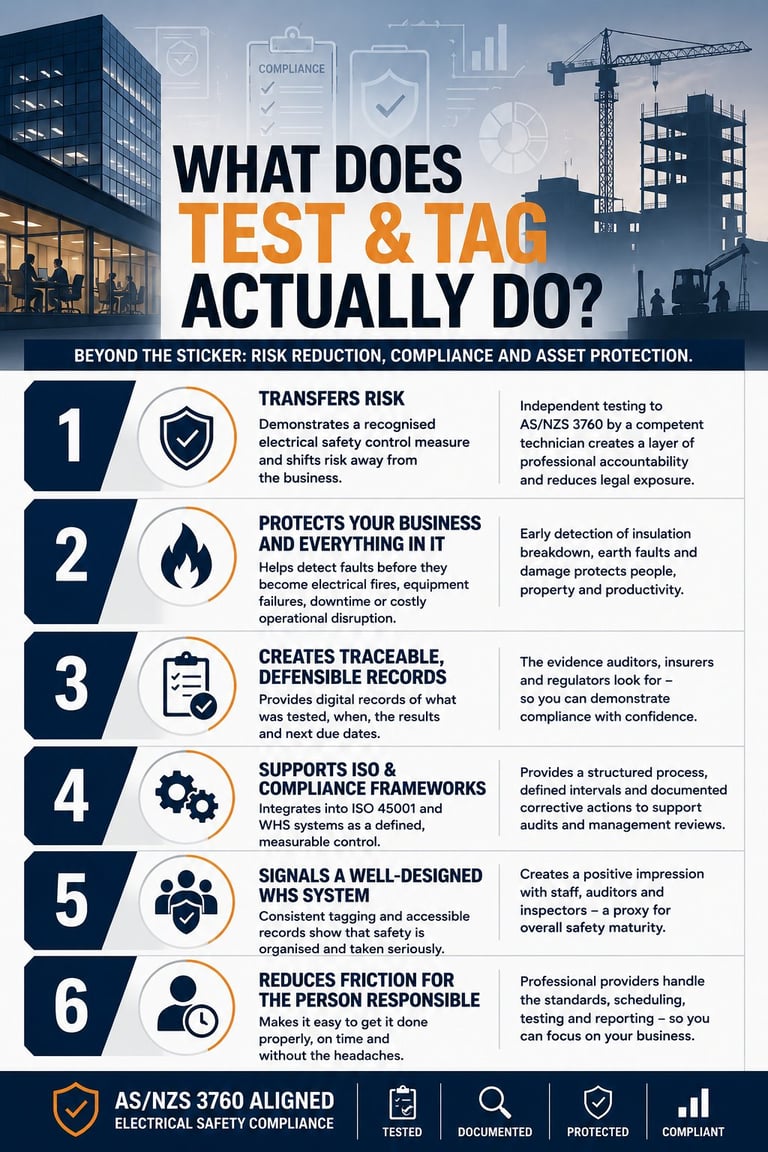
Every workplace that uses electrical equipment carries risk. Faulty leads, damaged plugs, internal failures — these aren't theoretical problems. They are common, and when they result in injury or fire, the responsibility sits with the business.
Test and tag changes that.
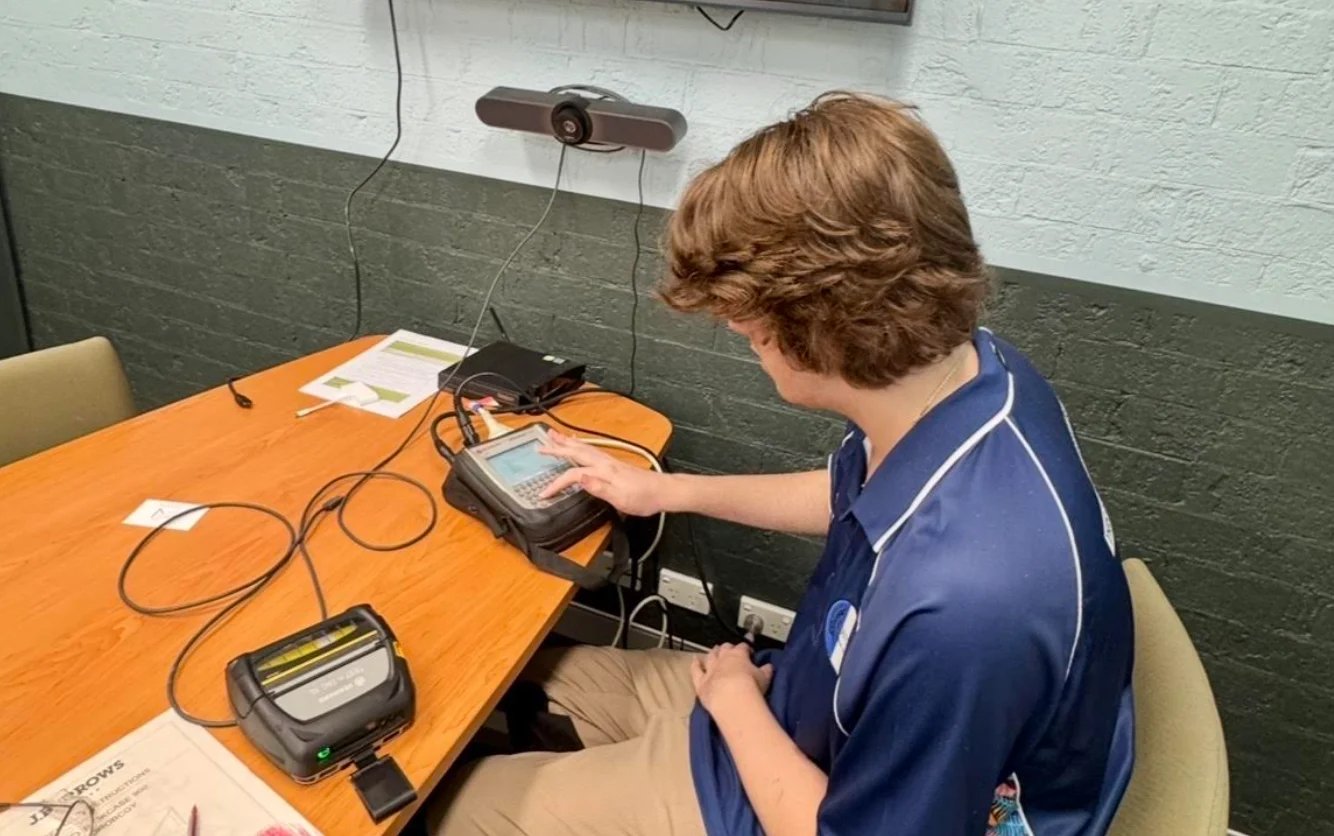
When a competent technician inspects and tests your equipment (to AS/NZS 3760 standards), they are not just "checking items." They are applying a recognised method, using calibrated testers, and documenting results against what is required under the Australian standards.
That matters, because it creates a layer of professional accountability.
Instead of relying on informal checks or assumptions, you now have a third-party service provider who has assessed the condition of your equipment, identified failures, and recorded outcomes. If an incident occurs, you are no longer exposed as a business that "should have known." You are a business that implemented a recognised control measure.
That is a very different position to be in during an investigation, an insurance claim, or a SafeWork review.
Most people associate electrical testing with preventing injury. That is only part of the story.
Electrical faults are one of the leading causes of workplace fires. A damaged lead in a lunchroom appliance, a failing power board under a desk, or a damaged tool in a warehouse can escalate quickly. The cost is not just the equipment — it's downtime, lost productivity, and in some cases, complete operational disruption.
Test and tag acts as a recurring, early detection system.
By identifying insulation breakdown, earth continuity issues, and visible damage before failure occurs, it reduces the likelihood of equipment becoming the ignition source of a larger incident. In that sense, it is not just a compliance activity — it is asset protection or 'proactive maintenance'.
For many businesses, the real value is not the tag on the lead. It is the prevention of a single event that could halt operations.
One of the most overlooked functions of test and tag is the documentation.
A professional service doesn't just test equipment and walk away. It generates a digital record of what was tested, when it was tested, the actual test results, and the next due date. Each asset becomes part of a traceable system.
This is where the real operational value sits.
If you are audited, asked to provide evidence of compliance, or need to respond to an incident, you are not relying on memory or paper notes. You have structured, searchable records that demonstrate:
That is what regulators, insurers, and auditors are actually looking for — not the tag itself, but the system behind it.
Without that record, you are legally exposed. With it, you have evidence. Insurers for instance will be looking at this if an electrical fire was to happen at your business.
For businesses working within ISO frameworks or formal WHS systems, test and tag is not a standalone task. It is part of a broader control environment.
Standards such as ISO 45001 (occupational health and safety) require organisations to identify hazards, implement controls, and maintain documented evidence of those controls. Electrical equipment is a clear and ongoing hazard category.
Test and tag fits directly into this structure. It provides:
This allows it to integrate cleanly into audits, management reviews, and compliance reporting.
In other words, it is not just something you "do once a year." It is something that demonstrates your safety system is functioning as intended.
There is also a less obvious effect — how your business is perceived.
When a workplace has clearly labelled equipment, consistent tagging, and accessible records, it sends a signal. To staff, it shows that safety is organised and taken seriously. To auditors and inspectors, it indicates that systems are in place and maintained.
This matters more than most businesses realise.
A well-executed test and tag program is often interpreted as a proxy for overall safety maturity. It suggests that other areas — fire equipment, emergency lighting, procedures — are likely being managed with the same level of structure.
That perception can influence how deeply a site is scrutinised, how audits are conducted, and how issues are escalated.
Finally, there is the practical reality.
In many workplaces, test and tag ends up being organised by someone who is already time-poor — often an office manager, administrator, or operations lead. Their goal is not to become an expert in electrical standards. Their goal is to get it handled properly, without disruption, and without it coming back as a problem later.
A structured test and tag service removes that burden.
Instead of chasing information, guessing compliance intervals, or worrying about whether it's been done correctly, the responsibility is handed to a provider who manages the process, the schedule, and the records.
That is where the real benefit often lands — not in the technical detail, but in the removal of uncertainty.
It moves electrical risk from you to the service provider.
It reduces your exposure.
It protects your assets.
It creates evidence.
It supports your compliance framework.
It demonstrates that your workplace is being managed properly.
If you're organising test and tag Sydney services, the question is not whether your equipment gets a tag. The question is whether the system behind it protects your business when it matters.
Because that is what test and tag is supposed to do.
Not just slap stickers on stuff and walk away.
We handle the testing, the schedule, and the records—so you're covered and don't have to think about it again.