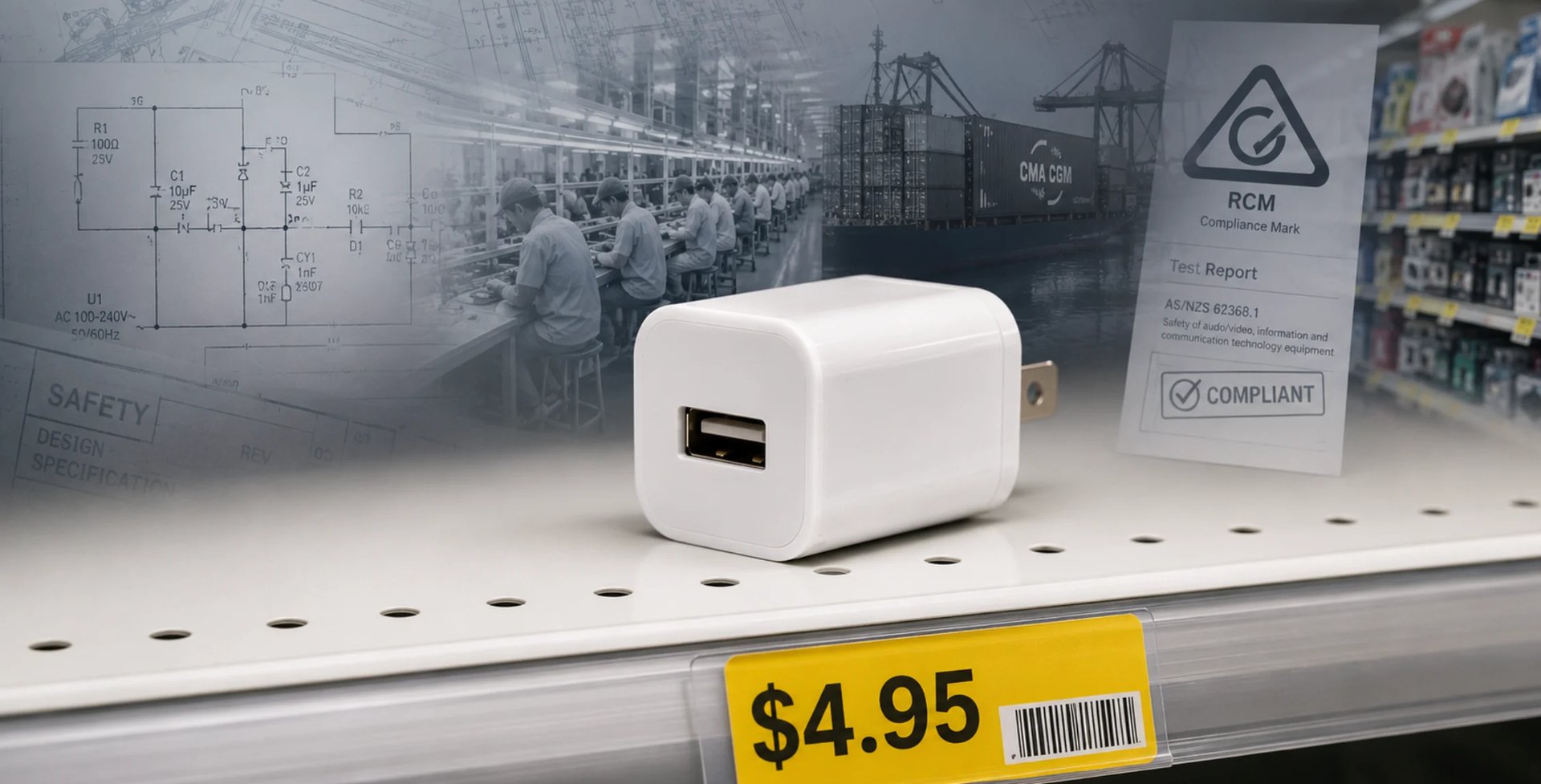
How a simple phone charger became lethal — and what every Australian should know about electrical product safety
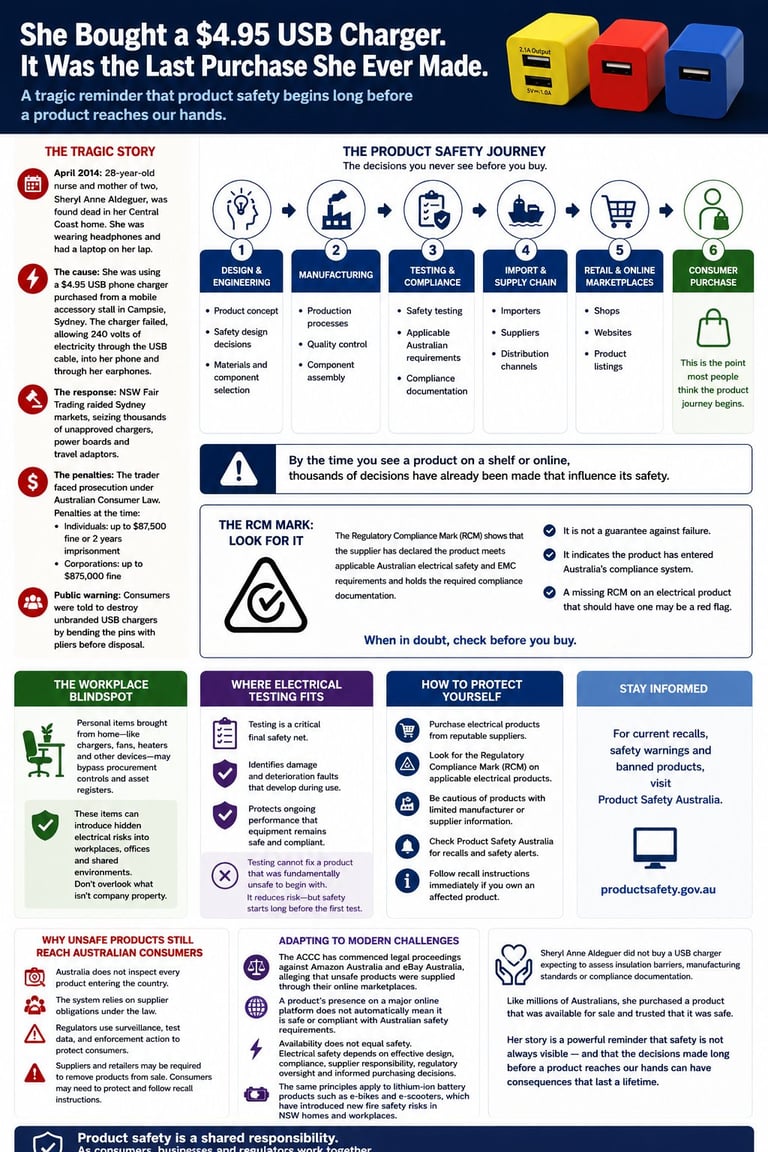
In April 2014, 28-year-old nurse and mother of two Sheryl Anne Aldeguer was found dead in her Central Coast home. She was wearing headphones and had a laptop resting on her lap.
Investigators found she was using a $4.95 USB phone charger purchased from a mobile phone accessory stall in Campsie, Sydney. The charger had failed, allowing 240 volts of mains electricity to travel through the USB cable, into her phone and through her earphones.
A product designed to perform one of the simplest tasks in modern life had become lethal.
The Response
NSW Fair Trading conducted raids across Sydney markets, including Campsie, Paddy's Markets and Dapto Markets, seizing thousands of unapproved electrical products including USB chargers, travel adaptors and power boards.
The trader involved faced prosecution under Australian Consumer Law. At the time, penalties included fines of up to $87,500 or two years imprisonment for individuals, and up to $875,000 for corporations.
NSW Fair Trading also issued a striking public warning: consumers were advised to destroy unbranded USB chargers by bending the pins with pliers before disposing of them so they could not be retrieved and used again.
A Confronting Question
How did a product capable of causing a fatal electric shock make its way into an Australian home?
Recent ACCC investigations involving products such as button battery items and high-powered magnets highlight an uncomfortable reality: the simple act of seeing a product available for sale in Australia can create an assumption that it is safe.
In many cases, that assumption is reasonable. Australia has consumer protection laws, mandatory safety requirements, product bans, recalls and regulators working to protect consumers.
However, recent recalls, investigations and enforcement actions demonstrate that unsafe or non-compliant products can still reach the Australian market.
For many electrical products sold in Australia, one of the most recognisable compliance symbols is the Regulatory Compliance Mark (RCM).
The RCM indicates that the supplier has declared the product meets applicable Australian electrical safety and electromagnetic compatibility requirements and that the required compliance documentation is held.
It is not a guarantee that a product can never fail. However, its presence shows that the product has entered Australia's electrical compliance system and that a responsible supplier has made a legal declaration regarding its compliance.
For consumers, a missing RCM mark on an electrical product that should carry one may be a warning sign that further investigation is required.
By the time a product reaches a shelf or online marketplace, it has already passed through many stages:
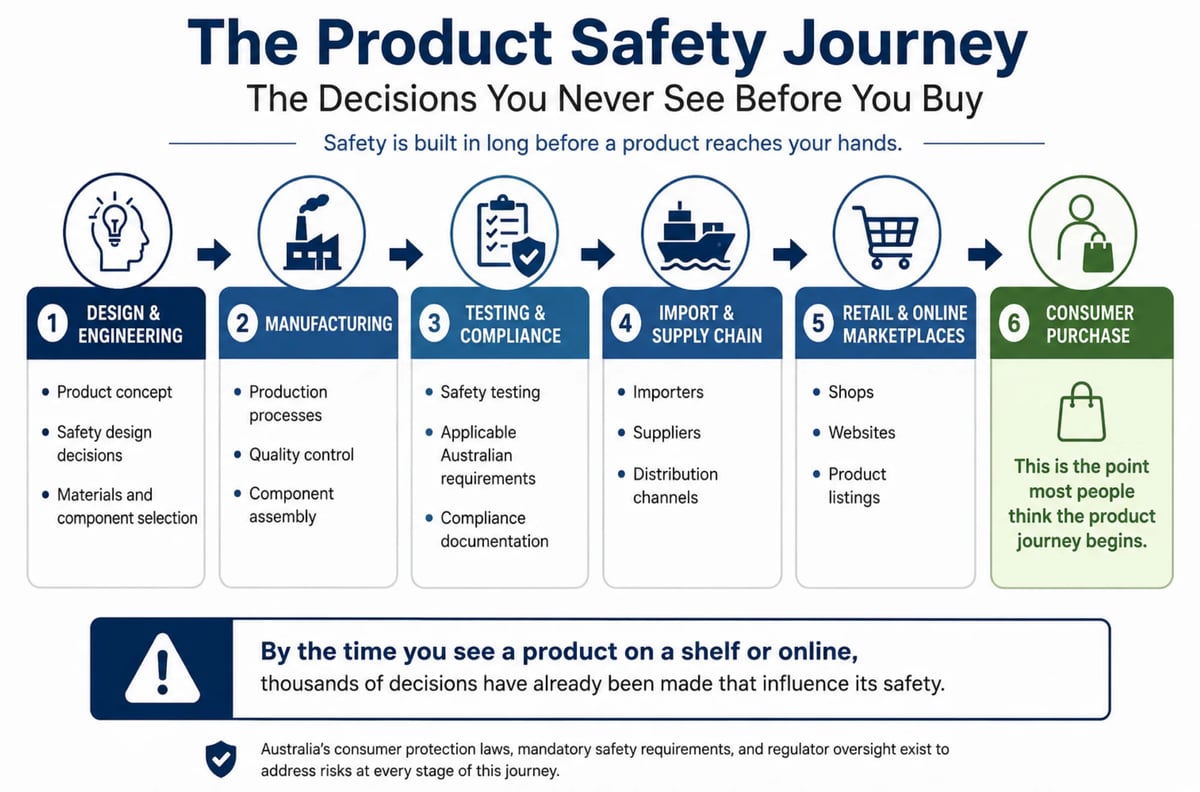
Every stage influences the safety of the final product.
Consumers naturally judge products by what they can see:
However, the most important decisions are often invisible:
These are the questions that Australian Standards, electrical safety laws and consumer protection systems are designed to address.
Many people assume every product entering Australia is individually checked before it reaches a shelf.
The reality is more complex.
Australia does not physically inspect every individual product entering the country. Instead, the system relies heavily on manufacturers, importers and suppliers meeting their legal obligations, supported by market surveillance, product recalls, investigations and enforcement action by regulators.
When unsafe products are identified, regulators can take action including product bans, recalls, infringement notices and court proceedings. Suppliers and retailers may be required to remove products from sale, while consumers may be asked to stop using affected products and follow recall instructions.
Adapting to Modern Challenges
The ACCC has commenced legal proceedings against Amazon Australia and eBay Australia, alleging that unsafe products were supplied through their online marketplaces.
The action is a powerful reminder that a product's presence on a major online platform does not automatically mean it is safe or compliant with Australian safety requirements.
Just as a low-cost USB charger purchased from a market stall led to a fatal tragedy in 2014, modern global marketplaces can also allow unsafe products to reach Australian consumers when compliance systems fail.
The underlying lesson remains unchanged: availability does not equal safety. Whether a product is purchased from a market stall, a major retailer or an online marketplace, electrical safety depends on effective design, compliance, supplier responsibility, regulatory oversight and informed purchasing decisions.
The same principles apply to lithium-ion battery products such as e-bikes and e-scooters, which have introduced new fire safety risks in NSW homes and workplaces.
This issue is not limited to products purchased through company procurement processes.
Many workplaces have strict controls around company equipment, yet personal devices brought from home — such as phone chargers, desk fans, heaters and other small appliances — can enter the workplace without the same level of oversight.
These items may not appear on asset registers and may bypass normal purchasing controls, creating an often overlooked electrical safety risk.
Personal electrical devices brought into the workplace represent a gap in many organisations' electrical safety management systems — one that deserves deliberate attention.
Electrical inspection and testing remains a critical safety control throughout a product's service life.
Testing can identify damage, deterioration, failed safety mechanisms and electrical faults that develop through everyday use. It also provides ongoing verification that equipment remains safe and compliant for continued use.
However, no amount of testing can change a product that was fundamentally unsafe due to poor design, inadequate manufacturing or non-compliance with applicable requirements.
A safe workplace depends on multiple layers of protection: responsible design, compliant manufacturing, supplier accountability, informed purchasing decisions and ongoing inspection and maintenance.
Practical steps include:
Sheryl Anne Aldeguer did not buy a USB charger expecting to assess insulation barriers, manufacturing standards or compliance documentation.
Like millions of Australians, she purchased a product that was available for sale and trusted that it was safe.
Her story is a powerful reminder that safety is not always visible — and that the decisions made long before a product reaches our hands can have consequences that last a lifetime.
Whether you're managing a workplace or protecting your family at home, electrical product safety starts with informed decisions. Liberty Test & Tag helps NSW businesses maintain compliant, defensible electrical safety systems.