If a worker climbed a ladder in your workplace right now, would you be confident it was safe to use? Or would you only discover a defect after a fall, injury or near miss? Many business owners, warehouse managers and site supervisors don't find out a ladder is unsafe until there's an incident, an inspection… or a workers compensation claim. That's why regular ladder inspections are so important in demonstrating your legal duty of care.
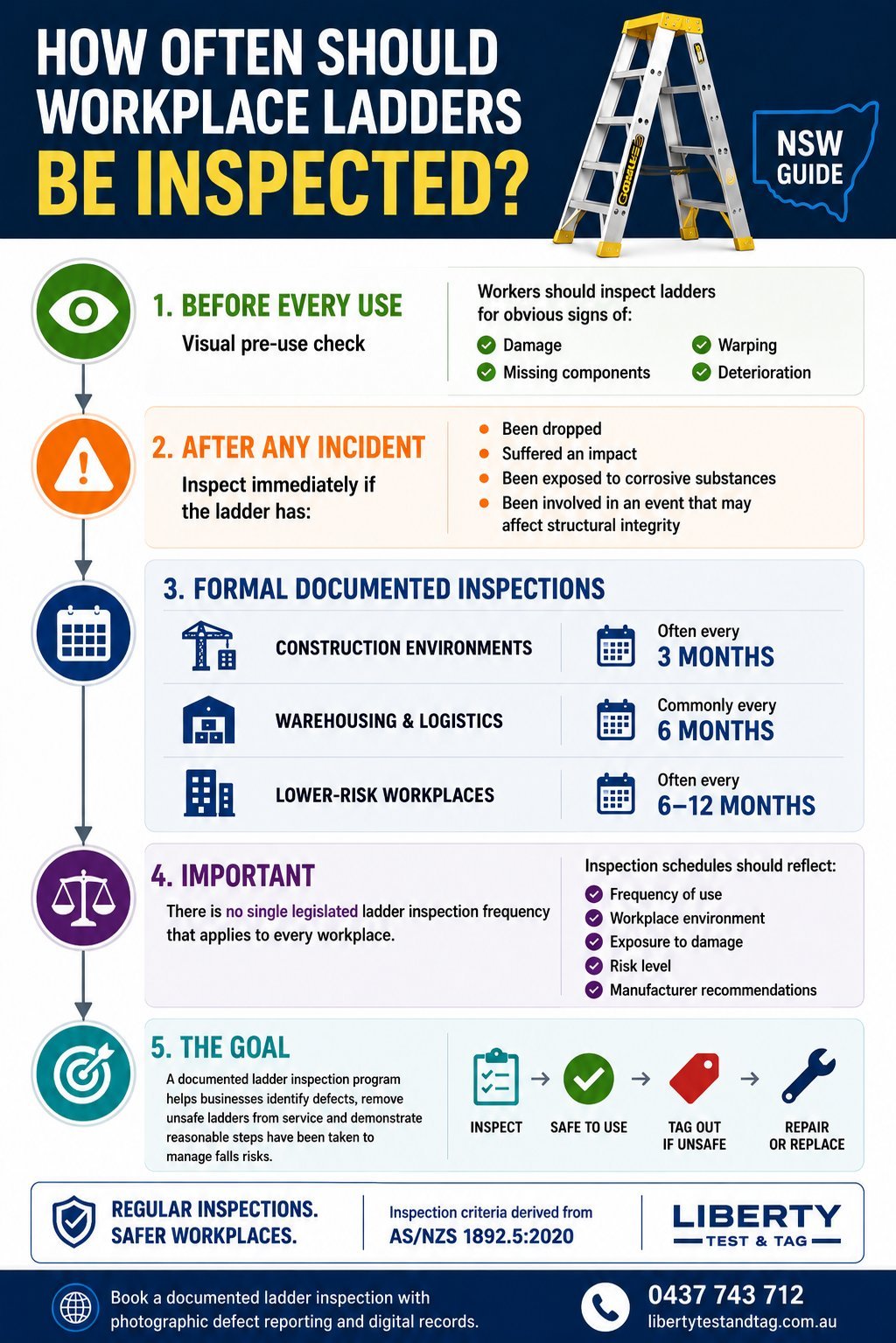
Unlike test and tag intervals, there is no single legislated ladder inspection frequency that applies to every workplace. Inspection schedules are risk-based and should reflect the ladder's environment, frequency of use and likelihood of damage.
For compliant workplace ladder inspections, including photographic defect reporting, ladder tagging and audit-ready digital records, see our ladder services page.
TL;DR
Many workplaces implement a documented 6–12 month inspection program, with more frequent inspections where ladders are exposed to heavy use, construction environments or increased risk of damage. Pre-use visual checks should be performed by workers before every use. A documented inspection program aligned with criteria derived from AS/NZS 1892.5:2020 can help businesses demonstrate that reasonable steps have been taken to provide workers with safe access equipment and manage falls-from-heights risks. This guide explains in plain English how an industrial-rated ladder in good condition functions, how inspection frequency is determined, what happens during a professional inspection, common failures we see in the field, SafeWork NSW guidance, and how to stay on top of compliance without disrupting your workplace.
An industrial-rated ladder in good condition provides a stable and reliable means of accessing areas that cannot be reached from the ground. Workplace ladders should be suitable for the task being performed and maintained in accordance with manufacturer recommendations.
In warehouses, logistics facilities, manufacturing plants and commercial workplaces, ladders are used every day to access shelving, storage locations, equipment and elevated work areas.
When a ladder is designed, manufactured and maintained in good condition, workers can rely on critical safety features such as maximum load capacity, maximum standing height, slip-resistant ladder shoes, secure locking mechanisms (spreaders) and structural integrity. These features help reduce the risk of slips, sudden movement, collapse and loss of balance while climbing or working from the ladder.
Safe work practices such as maintaining three points of contact remain essential, but they assume the ladder itself is fit for service. A damaged ladder can fail regardless of how carefully it is used.
This is why workplace ladder inspections are important. They provide a documented point-in-time assessment against defined criteria derived from AS/NZS 1892.5:2020. The ladder is either found suitable to remain in service, or it is identified as unsafe, tagged out, removed from service and recorded accordingly.
In Australia, workplace ladders should be inspected visually before every use. Additional inspections should be carried out whenever a ladder has been dropped, involved in an impact, exposed to corrosive substances or subjected to conditions that may affect its structural integrity. Inspection frequency is risk-based and should reflect the ladder's environment, frequency of use and likelihood of damage. As a practical guide, ladders used in construction environments are often inspected every three months, while ladders used in warehousing and logistics environments are commonly inspected every six months.
Every 3, 6 or 12 Months
Visual inspection and assessment against defined criteria to identify damage, wear, missing components and defects that may affect safe operation.
Before Use
Workers should visually inspect ladders before each use to identify obvious signs of damage, warping or deterioration.
As Needed
Any ladder identified as unsafe should be removed from service immediately, tagged out and either repaired in accordance with manufacturer recommendations or replaced.
In Practice: Workplace ladders in warehousing, logistics and industrial environments are commonly inspected every six months as part of a documented safety and compliance program.
Many workplaces implement a documented 6–12 month inspection program, with more frequent inspections where ladders are exposed to heavy use, construction environments or increased risk of damage. Ladders are generally best suited to lower-risk access tasks where higher-order controls such as scaffolding or elevated work platforms are not reasonably practicable.
A documented inspection schedule can help businesses demonstrate that reasonable steps have been taken to provide workers with safe access equipment and manage falls-from-heights risks.
To ensure this is done correctly and recorded for compliance, many workplaces engage a qualified provider.
SafeWork NSW identifies falls from heights as a primary cause of traumatic injuries and fatalities in NSW workplaces.
The SafeWork NSW Pocket Guide to Ladder Safety notes that dozens of serious ladder-related incidents occur each year, with many involving ladders that were used incorrectly or inappropriately. Workers in construction, manufacturing, retail and building maintenance are most commonly injured, however any worker using a ladder is at risk.
Importantly, serious and fatal falls can occur from both stepladders and extension ladders. As SafeWork NSW points out, it doesn't matter how far you fall. A fall from a relatively low height can still result in serious injury or death.
SafeWork NSW continues to investigate serious ladder-related incidents across NSW workplaces. In one 2024 incident, a 31-year-old worker suffered serious injuries after falling approximately three metres while descending a ladder on a construction site.
Work health and safety laws require businesses to eliminate falls risks where reasonably practicable and implement suitable controls where work at height cannot be avoided. While higher-order controls such as scaffolds, elevated work platforms and fall prevention systems should be used where appropriate, ladders remain widely used throughout warehousing, logistics, manufacturing and maintenance environments.
Because workers rely on ladders to safely access elevated areas, damaged or defective ladders can significantly increase the risk of a fall. SafeWork NSW guidance recommends that ladders be regularly inspected and removed from service if defects or faults are identified. Regular inspections help identify defects before they contribute to an incident.
Regular ladder inspections connect directly to WHS obligations, falls-from-heights risk management, insurance requirements and duty of care.
Missing inspections, failing to identify defects or leaving damaged ladders in service can create liability issues following an incident, workers compensation claims or workplace investigations.
A documented inspection record provides evidence that the ladder was assessed against defined criteria and either remained fit for service or was removed from use because it no longer met safety requirements.
A Liberty Test & Tag technician performs:
Recording ladder type, duty rating, height, manufacturer details and inspection information.
Assessing the ladder against inspection criteria derived from AS/NZS 1892.5:2020.
Applying inspection labels to compliant ladders and tagging out failed ladders with documented reasons for failure.
Providing photographic evidence, inspection records and clear documentation of compliance.
Documentation is Crucial: This documentation is crucial for audits, insurance, WHS record keeping and demonstrating that defective ladders were identified and removed from service.
Across Sydney, Western Sydney and broader NSW regions, common issues include:
The most common issue we encounter. Warped or twisted stiles can affect ladder stability and may indicate structural damage.
Worn, damaged or missing ladder shoes can reduce grip and increase the risk of slipping.
Cracked, bent, loose or excessively worn rungs and steps can affect safe climbing and footing.
Extension ladders rely on rope and pulley systems to safely raise, lower and secure the fly section. Frayed ropes, damaged pulleys and worn guide components are common defects.
Faded, damaged or missing manufacturer labels may prevent verification of the ladder's duty rating, model and intended use. Safety labels can be procured from the manufacturer if they cannot be seen due to paint splatter.
Extension ladders rely on rung locks to secure the fly section, while stepladders rely on spreaders to maintain stability. Damage to either component can affect safe operation.
The simplest way is to:
Set up recurring inspections to ensure ladders are assessed regularly.
Keep inspection records, photographs and defect reports available for review.
Tag out unsafe ladders and prevent further use until repaired or replaced.
Work with technicians who understand ladder inspection requirements and compliance obligations.
Book compliant workplace ladder inspections with Liberty Test & Tag.
Have you considered your emergency & exit lights ? Make a booking today.