Electrical Compliance
Yes, If You Plan to Stay in Business
Published: May 6, 2026
TL:DR; Cheap, high-volume "tag and run" compliance can absolutely become sticker slapper theatre. But electrical faults, fires, injuries, regulatory oversight, insurance investigations, and WHS obligations are very real. Proper test and tag is not about coloured stickers. It is about a rigorous process that identifies risk, documenting due diligence, and avoiding expensive failures before they happen.
For a lot of businesses, test and tag feels like compliance sticker theatre.
A technician arrives onsite, changes the colour of the tags on the electrical gear, prints a spreadsheet, sends an invoice, and leaves. Nothing looked broken beforehand. Nothing looks different afterwards. To many business owners, it feels like an electrical safety tax on their business designed more for show than practical safety.
And honestly, sometimes that criticism is on the money.
Inside the industry, there are colloquialisms for low-quality operators: "rag and tag" companies, "raggers", "sticker merchants", "tag and run guys", "tag jockeys", "compliance cosplayers". These are high-volume, low tag cost services focused more on processing large numbers than meaningful inspection and testing. Quick tagging. Minimal or no assessment. Maximum testing intervals (never coming back). Little consideration of the actual environment the equipment is operating in.
But here is the issue.
When an electrical fire shuts down operations, a worker receives a nasty shock from damaged equipment, or an insurer starts asking questions after an incident, the conversation shifts very quickly from: "Is test and tag worth it?" to: "How do we prove that we managed the risk properly?"
That is the real reason electrical compliance exists. Not stickers. Not slapdash test result spreadsheets. True and rigorous risk management.
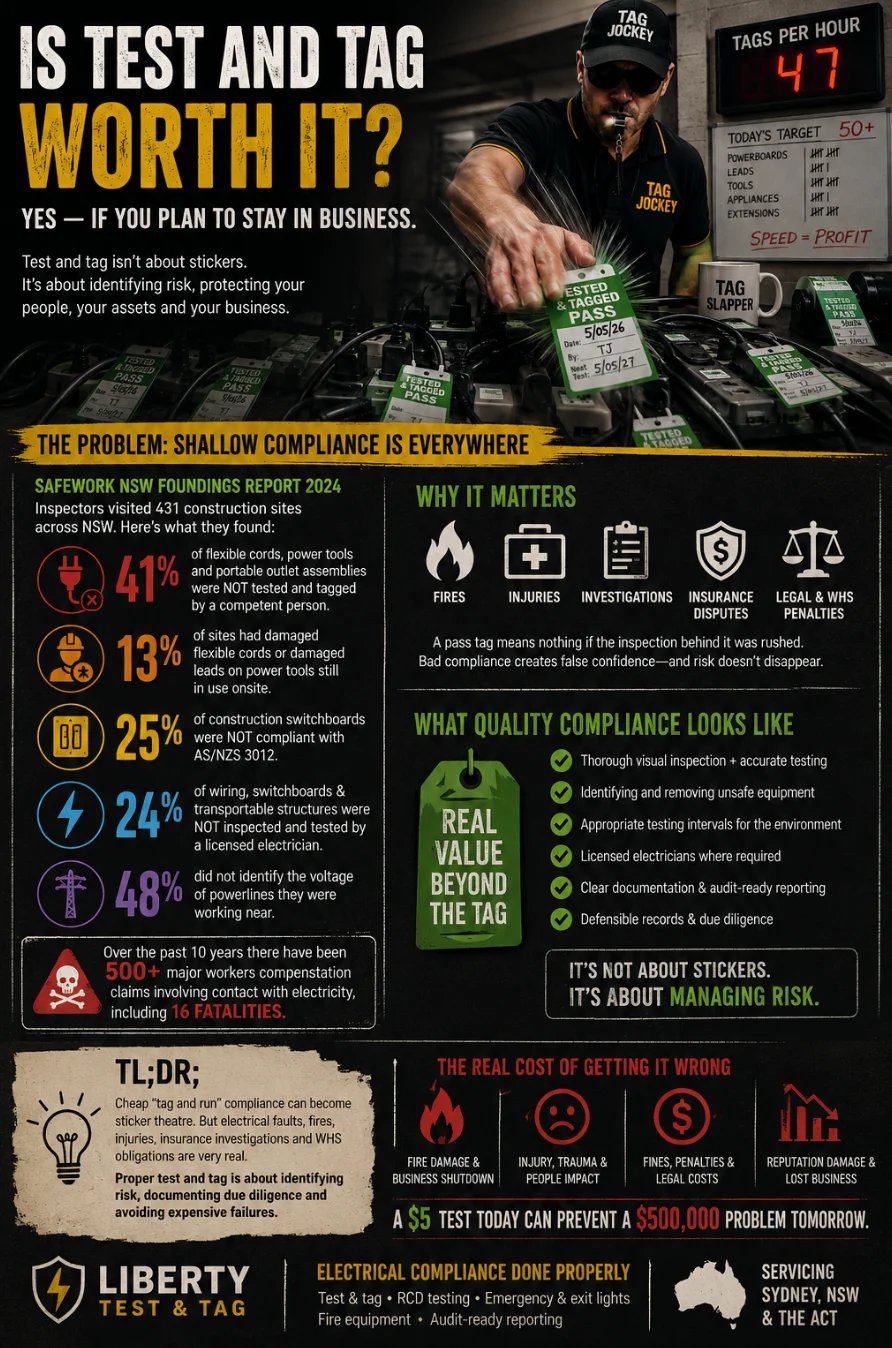
According to SafeWork NSW's 2024 Electrical Safety in Construction findings report, inspectors identified widespread non-compliance across hundreds of NSW construction sites, including:
The report also noted more than 500 major workers compensation claims involving contact with electricity over the past decade, including 16 fatalities.
For businesses, the issue is not simply whether equipment still turns on. It is whether electrical risks are being identified, managed, and documented before something goes wrong.
A pass tag is not magic.
It does not guarantee equipment will remain safe tomorrow. It simply confirms that at the time of inspection and testing, no faults were identified using the testing methods applied as per AS3760. Electrical safety is a shared responsibility when 90% of the faults identified arise from a thorough visual inspection.
That distinction matters.
Because rigorous electrical compliance is not about slapping stickers on cords. It is about identifying unmanaged risk before it becomes an operational, financial, regulatory or legal problem.
And this is where cheap, high-volume testing often falls apart. If a technician is expected to process 40, 50, or 60 items an hour, how much meaningful inspection is realistically occurring?
Damaged plugs and connectors
Crushed or frayed leads
Heat damage or discolouration
Overloaded power boards
Missing strain relief
Exposure to dust, vibration, moisture
Every item needs to be unplugged, inspected, plugged into the tester, test is then selected and applied, determining the outcome, the test result is printed out, applied to the flex cord or placed on the side of the appliance, then everything is plugged back in and energised to make sure it will turn on when the next person goes to use the piece of electrical equipment.
A 10amp heavy duty extension lead in a warehouse dispatch may look completely normal externally while the wiring inside the insulated cord has already been compromised from repeated crushing or forklift traffic.
A portable RCD may allow someone to plug in and use their angle grinder, but the safety switch may be inoperable or unsafe as it won't pass the safety threshold for a trip-time test at both 0 and 180 degrees of the sine wave.
An overloaded office powerboard may continue operating for months before eventually overheating under sustained load.
Poor compliance is not just ineffective, it can create false confidence. Once equipment has a fresh tag attached to it, there is a natural assumption that "everything has been checked properly." Staff stop questioning it. Managers stop thinking about it. The risk feels handled.
But shallow compliance does not remove electrical risk. It literally masks the electrical risk.
That is why quality visual inspection and testing matters. Not because tags themselves prevent incidents, but because cyclic, meaningful inspection, testing, and documentation reduce the likelihood of preventable failures while creating a solid evidentiary record that the business took all reasonable steps to manage electrical risk.
That's the key takeaway here.
Under NSW WHS obligations, businesses are expected to identify hazards, manage electrical risks, and maintain appropriate records relating to inspection and testing.
After an incident, investigators, insurers, and regulators are not especially interested in whether the tags matched the seasonal colour chart. They want to know:
If those records do not exist - or cannot be produced - your legal and financial standing becomes significantly harder to protect.
This is where electrical compliance shifts from "maintenance task" to business risk management. A structured compliance program helps demonstrate that the business took reasonable steps to identify and control foreseeable electrical hazards, especially when it is integrated into a well-developed WHS system.
Most business owners are not worried about 10amp extension leads. They are worried about risk to their teams, clients, operational downtime, liability, business interruption, reputational damage, and avoidable risk.
That is why proper compliance will always matter. Not because a coloured tag magically prevents incidents, but because structured visual inspections, testing, documentation, and risk management reduce unmanaged and unseen risk before it becomes a diabolically expensive problem.
And not all workplaces carry the same level of risk. A small office operating in controlled conditions is very different from: construction sites, warehouses, workshops, manufacturing facilities, hospitality venues, or high-use commercial environments. The Codes of Practice are quite clear on this.
Equipment ages. Dust accumulates. Leads are damaged. Power boards are overloaded. Portable equipment is exposed to vibration, movement, moisture, and mechanical stress.
That is why AS/NZS 3760 testing intervals are maximums - not guarantees of safety. Good compliance considers the actual environment and operational conditions of the workplace. Dodgy compliance just changes stickers.
If compliance is rushed, superficial, and focused purely on generating tags and spreadsheets, businesses are right to question its value.
Proper electrical compliance is not really about the tags at all. It is about:
Protecting people and place
Reducing unmanaged risk
Protecting operational continuity
Maintaining records that protect the business
Demonstrating due diligence
Identifying problems before they become expensive failures
A pass tag is cheap.
An electrical fire investigation is not.
At Liberty Test & Tag, we approach compliance as a structured risk-management system rather than a high-volume tagging exercise.
We provide:
For businesses across Sydney, NSW, and the ACT.
Because when something goes wrong, businesses do not need more stickers. They need compliance systems that are built to protect them.
Get in touch for a proper assessment of your electrical compliance needs in Sydney.