
Most aged care providers assume a 12-month testing cycle means they are compliant. That's not always correct. AS/NZS 3760 defines maximum testing intervals — not fixed rules for every environment.
Aged care environments are different from standard workplaces because residents are often vulnerable and may not be able to identify, report, or respond to electrical risk. This places greater responsibility on providers to ensure equipment is tested, maintained, and documented properly.
Testing also needs to be carried out around care routines. Residents may rely on predictable schedules, calm environments, and staff support, so testing should be planned in a way that avoids unnecessary disruption.
When electrical testing is poorly planned, it can affect both residents and staff. In aged care, the goal is not just to complete the testing, but to do it in a way that supports safe and stable care delivery.
Testing intervals should reflect how equipment is actually used within the facility.
| Environment / Equipment Type | Typical Testing Interval |
|---|---|
| General equipment | 12 months |
| Commercial kitchens | 6 months |
| Higher-use environments | Risk-based |
Standards set maximums — not defaults. Aged care environments often require more conservative intervals due to continuous use and higher risk.
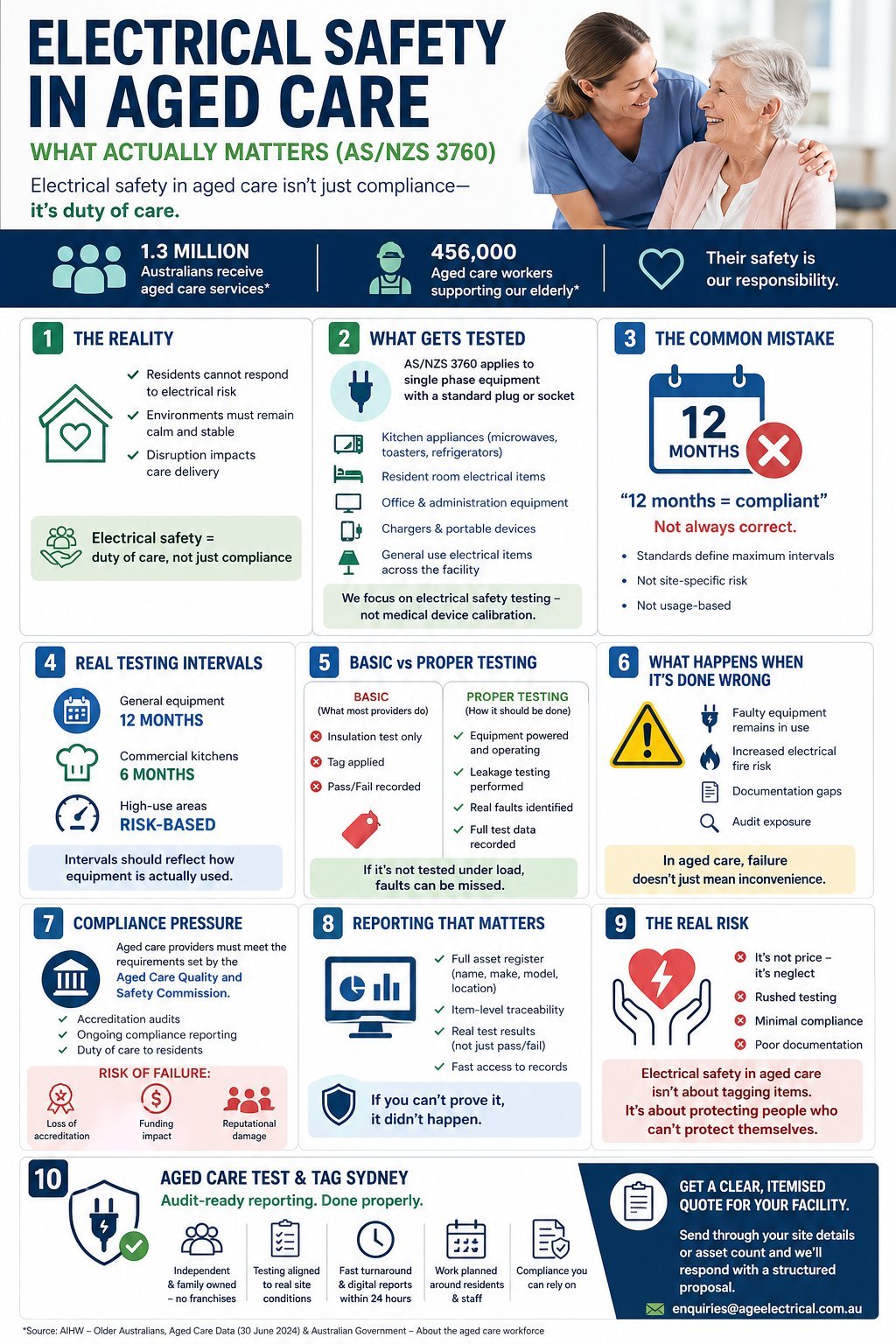
Basic testing may confirm that an item passes a limited check, but it may not always identify faults that occur when equipment is being used normally. In aged care facilities, equipment is often used daily, moved between rooms, handled by multiple people, and exposed to regular wear.
Testing under operating conditions, where appropriate, can help identify issues that static testing may miss. Equipment that appears safe at rest may develop faults during use.
When electrical testing becomes a simple checkbox exercise, real risks can be missed. Faulty equipment may remain in service because the testing process did not properly reflect how the equipment is used.
Risks may also be poorly documented, making it harder to prove that the facility has taken reasonable steps to manage electrical safety. In an aged care setting, documentation matters because responsibility remains with the provider.
The issue is not just whether testing was done. The issue is whether the testing was suitable, documented, and appropriate for the environment.
Aged care providers operate under strict regulatory oversight. Electrical safety forms part of maintaining a safe environment for residents, staff, visitors, and contractors.
Testing and tagging alone does not create compliance if the schedule, method, and records do not match the way the facility operates. Documentation should be clear enough to support audits, accreditation requirements, and internal safety reviews.
Good electrical safety management in aged care is practical, planned, and evidence-based. It supports duty of care by helping providers identify risk before it becomes a problem.
If your current testing schedule hasn't been adjusted for how your facility actually operates, you may be compliant on paper but exposed in practice. See our aged care test and tag Sydney service