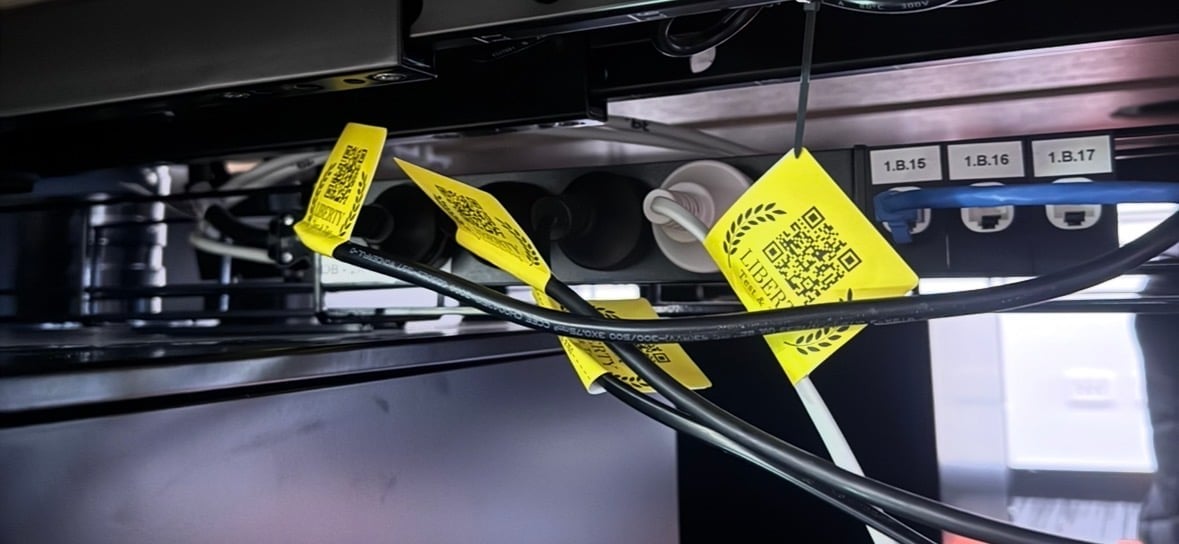
One of the biggest misunderstandings in electrical testing is assuming that "How many items?" automatically equals "How many electrical tests?"
In reality, detachable power leads, IEC cords, extension leads, powerboards and separately connected equipment may require individual inspection and testing under AS/NZS 3760.
That means a "1200 item" school may involve thousands of individual tests, while a "134 item" accommodation site may approach 500 tests once detachable leads and separately connected components are properly identified.
One of the most common questions in electrical testing is: "How many items do you have onsite?"
It sounds simple enough.
But in reality, "how many items" and "how many electrical tests" are often completely different things.
That difference is one of the biggest causes of inaccurate quotes, unrealistic time allocations and confusion between clients and contractors.
In many workplaces, electrical equipment counts are not based on a detailed asset audit. More often than not, they are based on rough estimates. A client may estimate the number of desks, monitors or printers onsite, and that estimate gradually becomes accepted as the site's "item count."
The problem is that modern workplaces accumulate electrical equipment organically over many years. Powerboards get added to split outlets, extra monitors appear for dual-screen setups, and equipment moves constantly between storage, workstations and active service.
This becomes particularly noticeable in places like schools, accommodation sites, offices and warehouses where equipment evolves continuously over time.
A school may historically report 1200 items.
But once detachable IEC leads, laptop chargers, extension leads, powerboards, classroom appliances, AV systems and specialist faculty equipment are properly identified, the actual number of electrical tests can increase dramatically.
Accommodation sites can become even more complex.
One accommodation site we attended was estimated by the client at approximately 134 items. Once multiple buildings, room appliances, detachable leads, extension leads and separately connected equipment were properly assessed, the actual number of electrical tests approached 500.
The original estimate was not intentionally misleading. It was simply based on a rough visual understanding of the site rather than a detailed assessment of every testable electrical component onsite.
A simple way to estimate electrical test numbers more accurately is this:
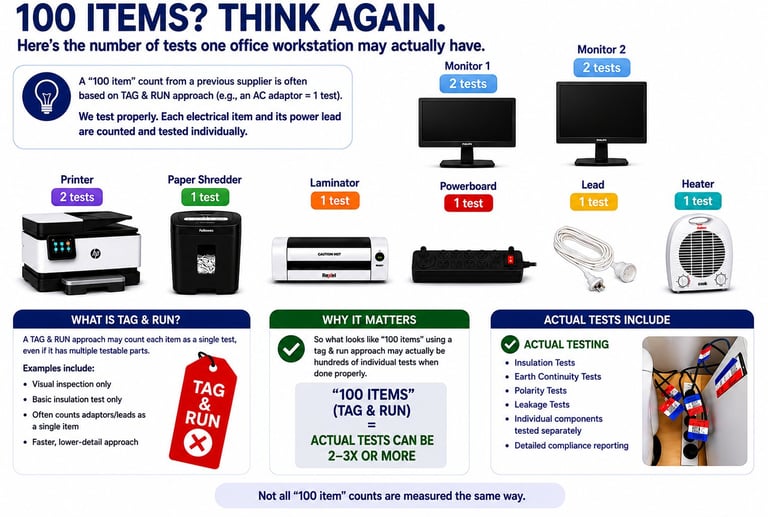
If the lead can be unplugged from the appliance, it may require separate inspection and testing under AS/NZS 3760.
AS/NZS 3760 Clause 2.1 specifically notes that where equipment is supplied by a cord set, both the cord set and equipment need to be tested and tagged separately. This principle is one of the reasons modern workplaces can contain significantly more individual electrical tests than clients initially expect.
In practical terms, detachable cord-connected components such as IEC leads, figure-8 leads, extension leads and detachable power supplies may require separate inspection and testing depending on the construction of the equipment and the testing methodology being applied.
For example, a monitor with a detachable IEC lead may involve inspection and testing of both the monitor and the IEC lead separately. A printer with a detachable power lead may also involve separate inspection and testing of the appliance and the lead. Extension leads and powerboards are generally tested individually as well.
This is why a workstation that visually appears to contain only a few "items" can legitimately generate significantly more individual electrical tests under AS/NZS 3760 inspection and testing procedures.
It is also important because detachable leads may require checks that are not necessarily performed when the lead remains permanently connected to the appliance during testing.
Where detachable leads are not individually inspected and tested, important checks normally performed on separately connected cord sets under AS/NZS 3760 may not be completed.
Another hidden issue in electrical testing is assuming inaccurate counts are always the technician's fault.
In reality, many factors shape what gets tested onsite. Large operational sites often have occupied work areas, inaccessible rooms, restricted sections, fixed budgets or operational limitations that affect what can realistically be completed during a visit. Technicians may be instructed to only complete certain buildings, avoid occupied classrooms, defer operational workshop areas or limit testing to fit within a fixed budget allocation.
Over time, those partial counts can become treated as though they represented the entire workplace.
There are also situations where clients unintentionally — or deliberately — distort item counts during quoting. Some businesses overestimate quantities because larger numbers often attract lower per-item pricing. Others underestimate because they are counting only the visible appliance itself rather than detachable leads and separately connected equipment.
The result is an industry where "We have about 200 items" can mean very different things depending on who counted, what was included, how the site was assessed and how the testing methodology was applied.
Understanding the difference between "How many items?" and "How many tests?" helps businesses budget more accurately, compare quotes more fairly and better understand what is actually being inspected and tested onsite.
Because in electrical testing, not all "100 item" counts are measured the same way.
Need a detailed electrical test and tag assessment for your workplace? We look beyond the surface count to identify every testable item onsite.
Get in touch