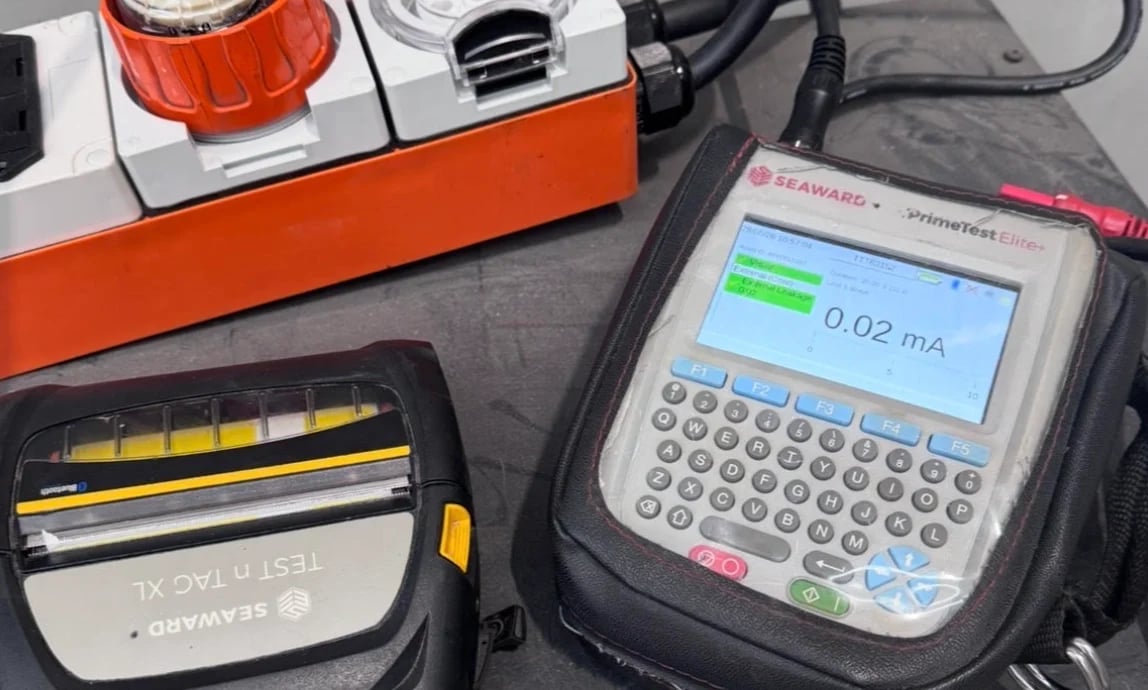
It is one of the most common questions business owners ask: "Can we just buy a portable appliance tester, send one of our staff on a one-day course, and do our own test and tag in-house?"
The honest answer is: Yes, provided the person performing the work genuinely meets the requirements of a "competent person" under AS/NZS 3760:2022. That part matters so much.
TL;DR
Yes, businesses can perform their own in-house test and tag in many situations, provided the person carrying out the work genuinely meets the requirements of a "competent person". AS/NZS 3760:2022 Clause 1.4.5 defines competency in terms of the knowledge and skills necessary to correctly and safely perform the task, while Appendix B provides guidance on the electrical knowledge involved. SafeWork NSW also makes an important point: a person carrying out testing should be competent to interpret the results produced by the test equipment they use. The real question is therefore not whether a business can buy a PAT tester — it is whether the organisation can maintain the competency, consistency and technical understanding required to operate a reliable electrical safety system over time.
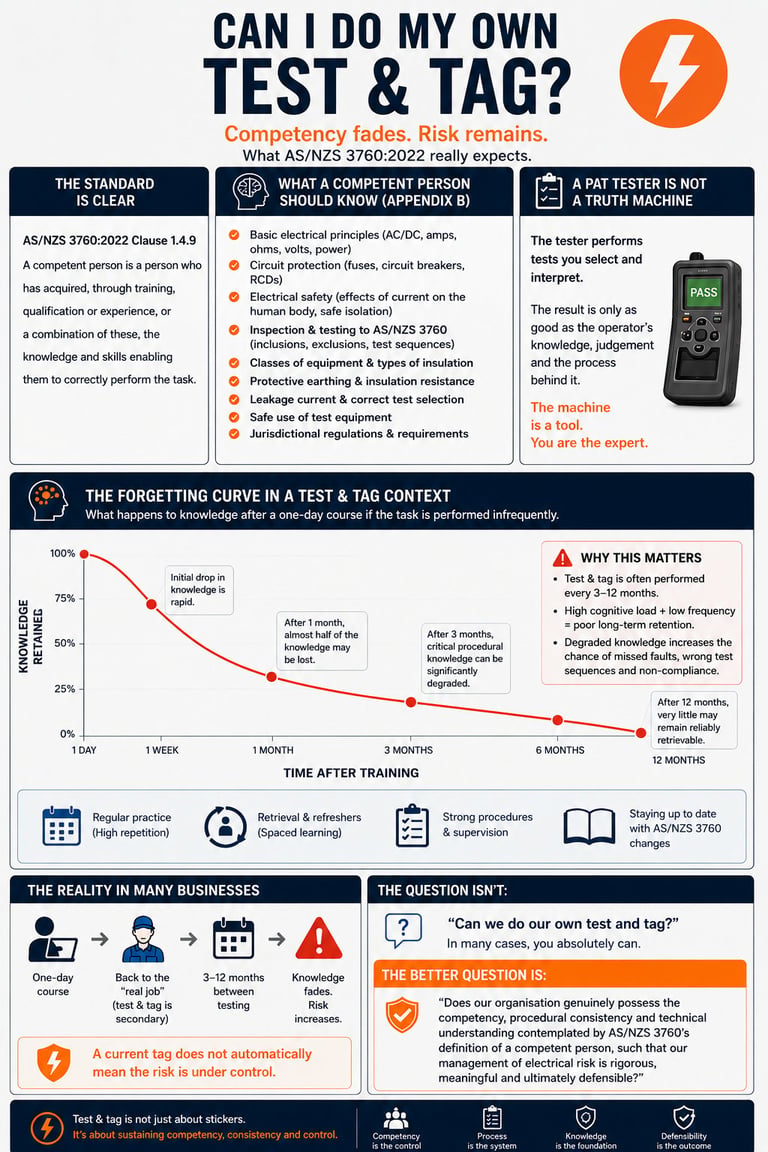
Because AS/NZS 3760 does not simply say: "Purchase a tester and press the green button."
Clause 1.4.5 defines a competent person broadly as somebody possessing the knowledge and skill necessary to correctly and safely perform the task.
More importantly, Appendix B of AS/NZS 3760:2022 then provides guidelines on the electrical knowledge a competent person should be familiar with. They are not advanced electrical engineering concepts but the fundamentals of electrical theory and practice.
That knowledge includes:
That is a very different picture than: "plug it in and print a sticker."
The standard envisions a knowledgeable operator making informed decisions — not simply a machine producing pass labels.
If you'd rather hand the whole program to a competent crew, our Sydney Test & Tag services cover the greater metro area with a single technician handling the testing, tagging and records end to end.
Most discussions about DIY test and tag focus on cost savings, convenience or legal compliance.
Very few discuss human cognition and how we acquire new knowledge and skills.
This is where things become interesting.
A one-day PAT testing course may successfully expose somebody to a large amount of procedural and electrical knowledge in a very short period of time. The problem is that seeing it once in a short course is not the same thing as long-term memory retrieval and retention of key information and skills.
Cognitive load theory, spacing theory and retrieval practice research have consistently shown that humans struggle to retain complex procedural knowledge when:
This is not controversial. It is established cognitive science.
More than a century ago, psychologist Hermann Ebbinghaus described what became known as the "forgetting curve." The principle was simple: without spaced repetition and repeated retrieval, humans forget information over time.
That matters enormously in DIY test and tag environments.
A worker attends a one-day course. They learn electrical classifications, test sequences, insulation testing, leakage testing, extension leads, RCDs and inspection procedures.
Then they return to their actual role in construction for another three months, best case scenario. Six months if they are in a warehouse, logistics or in a commercial kitchen.
By the next testing cycle, much of that procedural knowledge may already be falling out of yer noggin'.
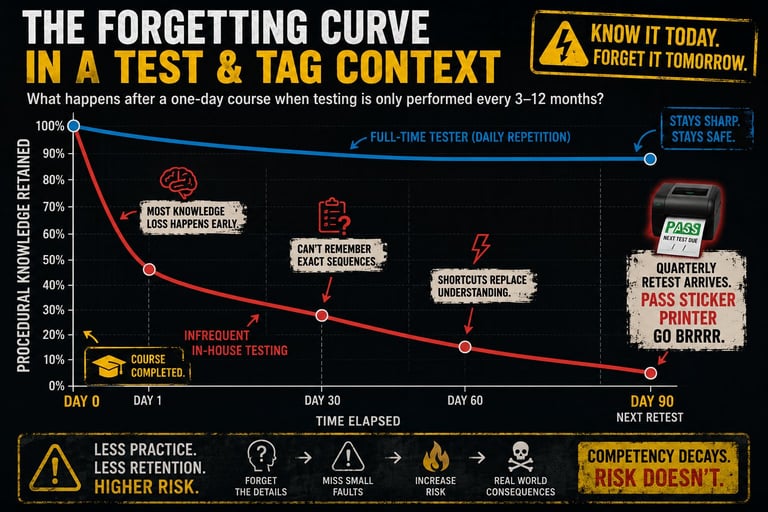
At that point, many workplaces begin unconsciously replacing deep understanding with simplified behavioural shortcuts:
"The machine said PASS."
"We test every three months."
"Everything has a current tag."
And eventually: PASS sticker printer go brrrr.
Funny meme. Potentially serious operational problem.
This is one of the most misunderstood parts of electrical compliance.
A portable appliance tester does not independently determine whether equipment is electrically safe. The machine performs tests chosen and interpreted by the operator within a framework chosen by the organisation.
SafeWork NSW specifically states that a person carrying out electrical equipment testing should also be competent to interpret the results produced by the test equipment they use. A numerical result or PASS indication therefore still depends on the operator selecting the appropriate inspection and test process and understanding what the result actually means.
That distinction matters enormously.
A PASS result does not, by itself, establish that the correct inspection, equipment classification, test sequence and interpretation have been applied.
Do they know what the RCM label is? Can I pass a powerboard old mate has brought back from Singapore?
That does not automatically mean the broader compliance system itself remains technically sound. It's just that the machine is not the expert — it is a tool, intended for use by someone who meets the criteria for being a 'competent person'.
The competency of the operator and the robustness of the methodology are what ultimately matter.
To be fair, some organisations absolutely do run excellent internal test and tag programs.
But those environments usually involve:
For NSW businesses, there is also a broader WHS consideration. Since 1 July 2026, section 26A of the Work Health and Safety Act 2011 requires PCBUs to comply with applicable approved Codes of Practice, unless another method provides an equivalent or higher standard of health and safety. Doing your own test and tag is therefore not just about whether one worker can operate a PAT tester — the business must also be able to show that its overall system is effectively managing electrical risk.
In other words, they unintentionally create the exact conditions cognitive science says are necessary for long-term retention and procedural competency.
That is very different from handing the tester to "Johnno on-the-tools" every three months between smoko breaks and knocking up frames.
The question is not: "Can we do our own test and tag?"
In many cases, you absolutely can.
For businesses that prefer to outsource the work, Liberty provides Test & Tag services across Sydney, Test & Tag services across Canberra and the ACT and Test & Tag services in Lithgow.
The better question is:
"Does our organisation genuinely possess the competency, procedural consistency and technical understanding contemplated by AS/NZS 3760's definition of a competent person, such that our management of electrical risk is rigorous, meaningful and ultimately defensible?"
Because electrical compliance is not simply about whether Johnno has done the rounds with the sticker maker.
It is about maintaining a technically and procedurally sound safety system long after the one-day course is over.
If you'd rather focus on running your business while professionals handle your electrical compliance, we're here to help. Our technicians operate within a robust system built on competency, consistency and technical rigour.