Test & Tag in warehouses, logistics centres and manufacturing facilities is routine WHS risk management, not an added cost. Equipment is dispersed, heavily used, and subject to environmental and mechanical stress. Proper testing means de-energised inspection, measured electrical results, and documentation that stands up to scrutiny. When done properly, it protects both people and operations.
2026 update: In NSW, electrical inspection and testing duties are now framed under the Work Health and Safety Regulation 2025, including requirements for equipment used in conditions where it may be exposed to damage, moisture, heat, vibration, dust or other hostile operating conditions. For warehouses and logistics sites, this reinforces the need for risk-based test intervals, proper electrical testing, and records that show the work was actually completed.
Running a busy warehouse or logistics site? We provide compliant Test & Tag with minimal disruption, early starts, and clear digital reporting across NSW and ACT.
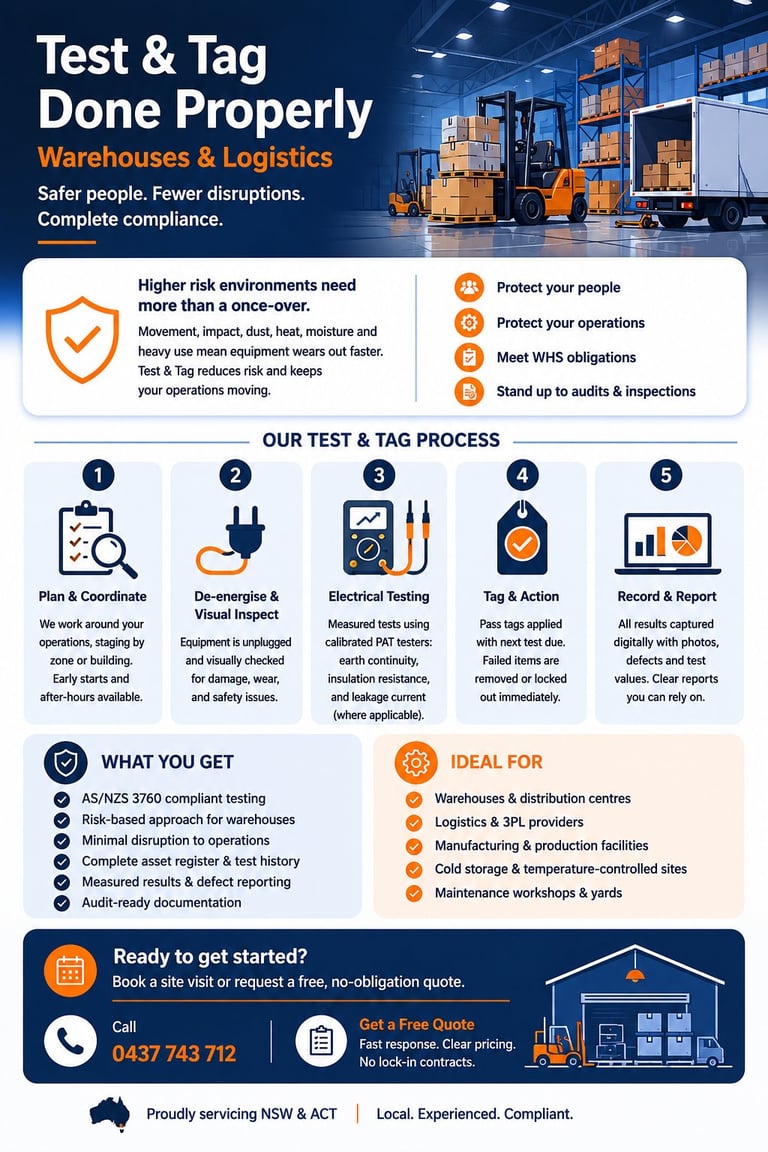
Why Warehouses and Logistics Sites Are Different
Warehouses and distribution centres present higher electrical risk than office environments. Equipment is spread across large areas, moved frequently, and exposed to mechanical stress from forklifts, pallet jacks, and heavy loads.
Battery chargers run continuously. Extension leads and powerboards are deployed temporarily to support loading, packing, or maintenance operations. Equipment gets knocked, dragged, or subjected to dust, moisture, and temperature variation.
Fault rates are higher. Testing intervals need to reflect actual usage and environmental conditions, not generic assumptions. For many warehouse environments, a 12-month office-style assumption may not be appropriate; intervals should reflect the actual risk created by movement, dust, impact, heat, moisture and equipment use.
What "Proper" Test & Tag Actually Means
Proper Test & Tag under AS/NZS 3760 requires equipment to be de-energised and disconnected before testing. A visual inspection is performed first — checking plugs, cords, strain relief, and appliance casings for damage or deterioration.
Electrical testing follows, using calibrated PAT testers. This includes earth continuity tests for Class I items, insulation resistance tests, and leakage current measurement where applicable. Results are measured and recorded, not estimated.
Items that fail are locked out or removed from service immediately. Pass tags display the test date, next test due, and tester details. Every test is logged digitally with asset identifiers and measured values.
Visual-only tagging without electrical testing is not compliant. Neither is testing equipment while still plugged in or energised.
Planning Around Operations
Testing in a busy warehouse requires coordination. The goal is to minimise disruption while ensuring all equipment is tested properly.
Liberty schedules testing to avoid peak dispatch periods. Testing often starts before 8:30am, when fewer staff are on-site and operational activity is lower. For larger sites, testing is staged by zone or building, allowing parts of the facility to continue operating while testing proceeds elsewhere.
Temporary equipment like extension leads and portable tools can be grouped and tested during scheduled maintenance windows or after-hours, if preferred. The key is planning the sequence with operations managers so critical functions remain uninterrupted.
Need testing completed without stopping dispatch or production? Liberty stages testing by zone, before-hours or after-hours, so operations keep moving.
The On-Site Process
Liberty's on-site process follows a systematic method designed to ensure nothing is missed and all testing is defensible.
Each zone or room is labelled. A room-by-room approach ensures all equipment is accounted for. Each item is unplugged, visually inspected, and electrically tested according to its appliance class, Class I, Class II, leads, RCDs, or powerboards.
Testing is performed with calibrated PAT testers that record measured values for earth resistance, insulation resistance, and leakage current. Pass or fail tags are applied on-site. Unsafe items are locked out or physically removed from the workplace.
Hazards identified during testing, for example, damaged cords, broken strain relief, or missing earth pins, are documented and reported. Results are captured digitally in real time, including defect notes and photos where relevant.
This process creates a complete record of what was tested, when, and with what result—suitable for audits, insurance reviews, and WHS inspections.
Documentation That Stands Up to Scrutiny
Documentation is what makes Test & Tag defensible. A tag on an appliance shows compliance at a glance. The supporting records show the testing data.
Liberty provides a complete asset register showing every item tested, including make/model, location, and unique identifier where applicable. Test histories track results over time, highlighting trends or recurring faults.
Measured results are recorded for each test; earth resistance, insulation resistance, and leakage current values where applicable. Defect notes document any issues found and actions taken.
This creates an audit trail that satisfies SafeWork inspectors, insurer requirements, and formal WHS or ISO management systems. It shows that testing was done properly, not just performed as a checkbox exercise.
How Test & Tag Supports a Functional WHS System
Test & Tag is not a standalone activity. It integrates with WHS systems and practices; maintenance schedules, risk registers, and preventive control measures.
Defect data identifies patterns, such as frequently damaged leads in loading zones or recurring faults in specific equipment types. This information feeds into hazard management and procurement decisions.
RCD testing, emergency lighting checks, and fire equipment inspections can be coordinated with Test & Tag cycles, reducing administrative burden and ensuring all compliance activities are synchronised.
A functional WHS system treats electrical compliance as routine operational maintenance, not a periodic add-on. Test & Tag is one element of that system, proactive, documented, and integrated.
Common Misunderstandings
Some businesses assume visual tagging without electrical testing is sufficient. It is not. AS/NZS 3760 requires both visual inspection and electrical testing.
Others believe equipment can be tested while still energised or plugged in. This is incorrect and unsafe. Proper testing requires de-energised equipment.
Low-risk areas such as offices or staff rooms are sometimes overlooked. All portable electrical equipment in the workplace must be tested, regardless of perceived risk.
Finally, Test & Tag is not a once-off task. It is cyclical. Equipment must be retested at intervals appropriate to its use, environment and risk profile, especially where leads, chargers, tools or portable equipment are exposed to hostile warehouse conditions.
Warehouses and logistics centres require staged, systematic testing with documented evidence. Competent Test & Tag protects people, supports operations, and integrates with a functional WHS system. When testing is done properly, it becomes routine risk management — not an afterthought.
Protect your staff, equipment and compliance records with proper, defensible testing. Speak with Liberty about scheduled Test & Tag, RCD testing and complete site reporting.
Learn more about our approach to electrical compliance done properly.