Test & Tag for Schools and Childcare: A Practical Guide for School Administration Managers

February 2025
6 min read
School Safety
Electrical test and tag equipment being used in a school setting

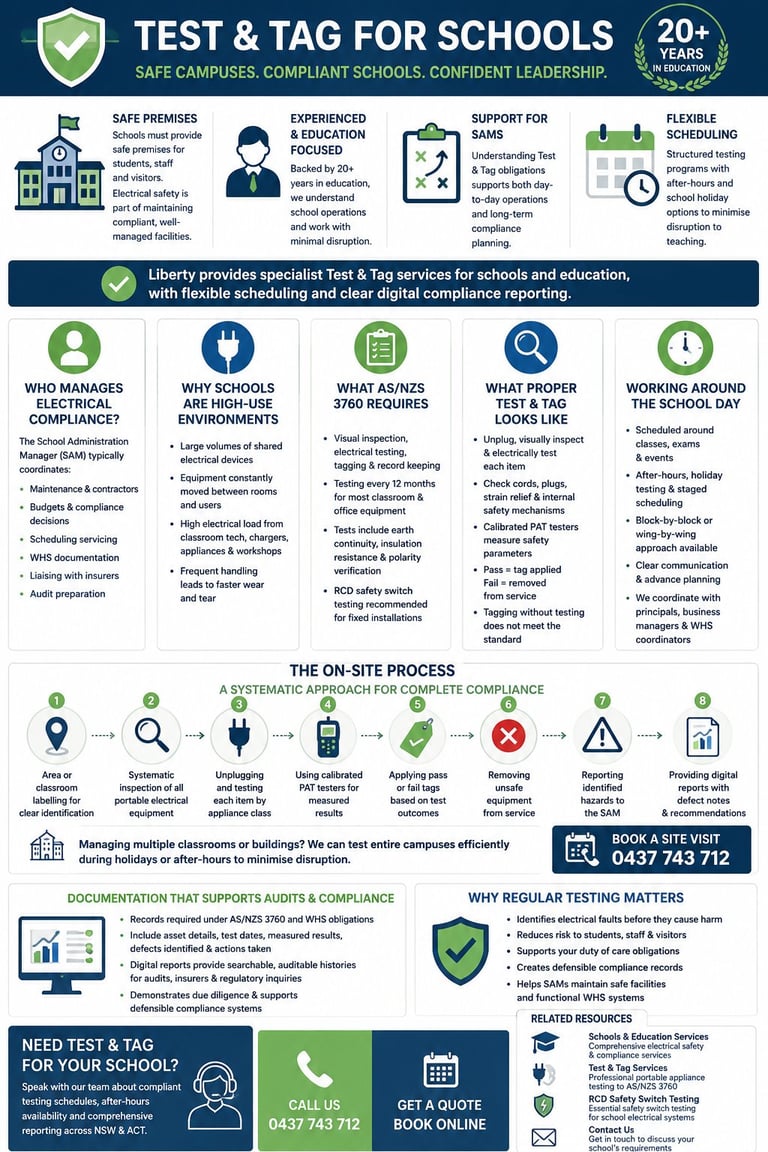
Schools must provide safe premises for students, staff and visitors. Electrical safety is part of maintaining compliant, well-managed facilities.

Backed by 20+ years in education, we understand school operations and work with minimal disruption.

For School Administration Managers (SAMs), understanding Test & Tag obligations supports both day-to-day operations and long-term compliance planning.

Planning your school's next Test & Tag cycle? We provide compliant, after-hours testing with clear digital reporting for NSW and ACT schools.

Who Manages Electrical Compliance in Schools

The School Administration Manager typically coordinates maintenance, contractors, budgets and compliance decisions.

This role often includes scheduling servicing, managing WHS documentation, liaising with insurers and preparing for internal or external audits.

Understanding what proper Test & Tag involves allows SAMs to evaluate contractors, manage expectations and maintain defensible records.

Why Schools Are a High-Use Electrical Environment

Schools operate large volumes of shared electrical devices. Equipment moves constantly between rooms, classes and users.

Laptop trolley chargers, USB chargers, classroom technology, canteen appliances and TAS/workshop equipment all contribute to high electrical load and frequent handling.

Wear and tear occurs faster than many expect. Cords are pulled, devices are dropped and plugs are handled repeatedly throughout each term.

This environment creates ongoing electrical safety considerations that must be managed systematically.

What AS/NZS 3760 Requires

AS/NZS 3760 is the Australian and New Zealand Standard for in-service safety inspection and testing of electrical equipment.

It requires visual inspection, electrical testing, tagging and record keeping for portable electrical equipment.

Testing intervals depend on the equipment class and operating environment. Schools typically require testing every 12 months for most classroom and office equipment.

The standard specifies measurable electrical tests including earth continuity, insulation resistance and polarity verification.

Schools should also consider RCD safety switch testing as part of a comprehensive electrical safety program for fixed installations.

What Proper Test & Tag Looks Like in a School

Compliant testing requires each item to be unplugged, visually inspected and electrically tested — not just tagged.

The technician examines cords for damage, checks plug condition, inspects strain relief and tests internal safety mechanisms.

Calibrated Portable Appliance Testers (PAT) measure electrical safety parameters. Items that pass receive a compliance tag. Items that fail are removed from service.

Tagging without testing provides no safety value and does not meet the standard's requirements.

Working Around the School Day

Work scheduled around classes, exams and events to minimise disruption.

After-hours work, school holiday testing and staged scheduling allow testing to proceed without affecting teaching time.

Block-by-block or wing-by-wing scheduling can be arranged to suit operational needs and budget constraints.

Advance planning and clear communication with staff help testing proceed smoothly.

We coordinate directly with principals, business managers and WHS coordinators.

The On-Site Process

Liberty's workflow follows a systematic approach:

  • Area or classroom labelling for clear identification
  • Systematic inspection of all portable electrical equipment
  • Unplugging and testing each item by appliance class
  • Using calibrated PAT testers for measured results
  • Applying pass or fail tags based on test outcomes
  • Removing unsafe equipment from service
  • Reporting identified hazards to the SAM
  • Providing digital software-generated reports with defect notes

This structured process ensures consistent coverage and complete documentation.

Managing multiple classrooms or buildings? Liberty can test entire campuses efficiently during holidays or after-hours to minimise disruption.

Documentation That Supports Audits and Compliance

Proper record keeping is required under AS/NZS 3760 and supports WHS obligations.

Records should include asset details, test dates, measured results, defects identified and actions taken.

Digital reports generated by testing software provide compliance reports with searchable, auditable histories suitable for internal reviews, insurance assessments and regulatory inquiries.

Maintained records demonstrate due diligence and support defensible compliance systems.

Why Regular Testing Matters

Regular testing identifies electrical faults before they cause harm.

It reduces risk to students, staff and visitors while supporting the school's duty of care obligations.

Consistent testing creates defensible compliance records that demonstrate responsible site management.

For School Administration Managers, maintaining a regular testing schedule supports safe facilities and functional WHS systems.

To explore comprehensive compliance support for educational institutions, visit our dedicated schools and education services page.

Competent testing supports safe facilities and responsible site management for schools.

Learn more about our approach to electrical compliance done properly.

Don't wait for an audit or incident to review compliance. Keep your school safe and fully documented with professional Test & Tag, RCD testing and reporting.