Choosing a Test & Tag provider isn't just about price. If something goes wrong, an incident, an audit, an insurance query, your documentation and testing process matter. A quality provider educates, informs and helps reduce electrical risk, keeps records clean, and applies the right test intervals for your environment.
The wrong provider doesn't just waste money, it exposes your business to compliance gaps that could cost you dearly in a SafeWork inspection or insurance claim.
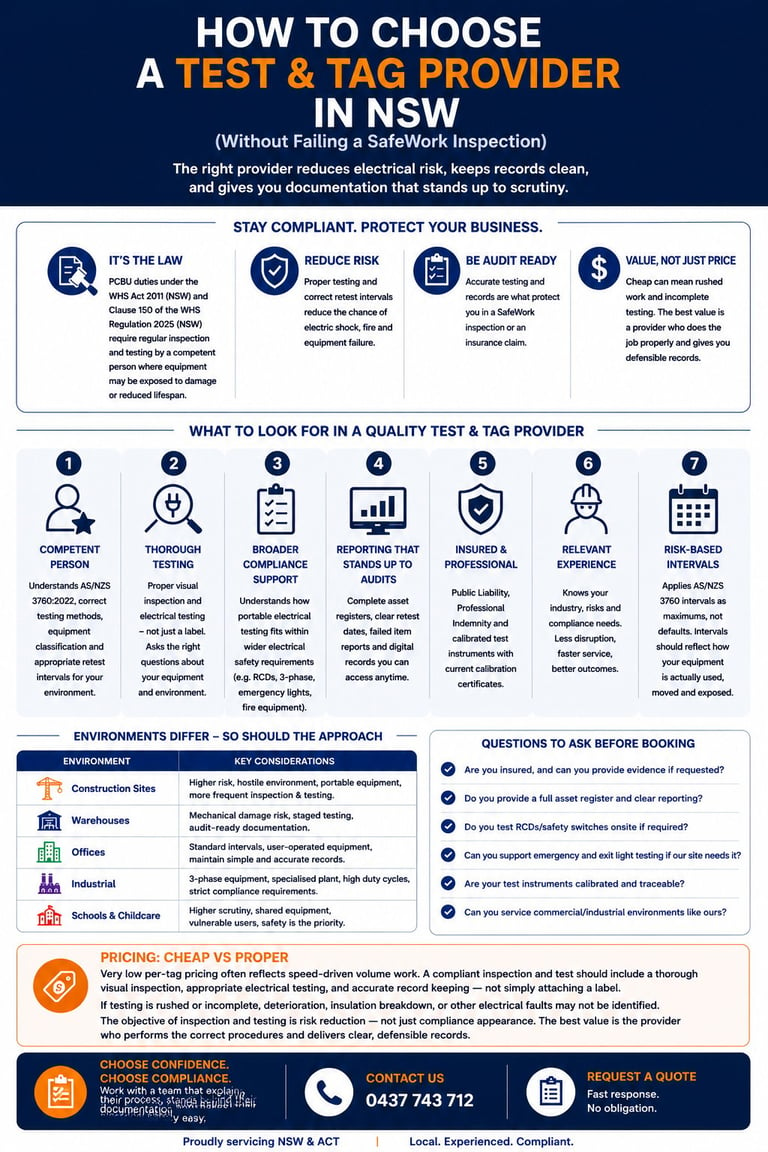
Under the Work Health and Safety Act 2011 (NSW), a person conducting a business or undertaking (PCBU) must ensure, so far as is reasonably practicable, that electrical equipment used at work is safe and properly maintained.
Clause 150 of the Work Health and Safety Regulation 2025 (NSW) requires plug-in electrical equipment to be regularly inspected and tested by a competent person where it is used in conditions likely to result in damage or reduced lifespan.
In practice, most NSW workplaces adopt AS/NZS 3760 as the recognised framework for meeting this obligation and producing defensible inspection and testing records. A credible provider should understand how this standard applies to your specific equipment, environment and risk profile. Importantly, AS/NZS 3760 inspection and test intervals are maximum recommended intervals, not automatic defaults. A competent provider should assess how equipment is actually used, moved, exposed, and maintained within the workplace environment.
Look for a provider who can explain their competency clearly. Beyond having completed training, they should understand correct testing methods, how to classify equipment, and how to apply inspection and test requirements to real workplace conditions.
A truly competent person understands:
Many operators only know how to plug a tester in and attach a label. That's not competency—that's checkbox compliance.
A quality provider should understand how portable electrical testing fits within broader workplace electrical safety compliance requirements, not only basic tagging. Ask whether they can handle the equipment and environments you operate in, including higher-risk settings and specialised plant.
A comprehensive provider should offer:
Essential for protecting workers from electric shock
For commercial and industrial machinery
Compliant with AS 2293 for building safety
AS 1851 maintenance for fire safety systems
Your records are often the most important output of the job. Expect clear reporting, asset registers, retest dates, and visibility over failed items. A good provider makes it easy to demonstrate your process and follow-up actions.
In an insurance claim or SafeWork audit, documentation is what protects you. Make sure your provider delivers:
Professional providers should carry appropriate insurance and use calibrated test instruments. If they can't produce calibration details or operate without clear business credentials, that's a risk for your site.
Before booking, verify:
Offices, warehouses, construction, logistics, schools, and industrial sites all create different risk profiles. A provider with relevant experience will move faster, identify issues earlier, and apply intervals and methods correctly for your environment.
Different environments require different approaches:
| Environment | Key Considerations |
|---|---|
| Construction Sites | Higher risk, hostile environment, portable equipment |
| Warehouses | Mechanical damage risk, staged testing, audit-ready documentation |
| Offices | Standard intervals, user-operated equipment |
| Industrial | 3-phase equipment, specialized plant, strict compliance |
| Schools & Childcare | Higher scrutiny, shared equipment, safety priority |
Very low per-tag pricing often reflects speed-driven volume work. A compliant inspection and test should include a thorough visual inspection, appropriate electrical testing, and accurate record keeping — not simply attaching a label.
For example, certain classes of equipment require additional testing procedures beyond a basic continuity check. If testing is rushed or incomplete, deterioration, insulation breakdown, or other electrical faults may not be identified.
The objective of inspection and testing is risk reduction — not just compliance appearance. The best value is the provider who performs the correct procedures and delivers clear, defensible records.
Use this checklist when evaluating potential providers:
If you want a provider who focuses on compliance, clear reporting, and minimal disruption, choose a team that can explain their process, stand behind their documentation, and scale with your site needs.